


 Play store


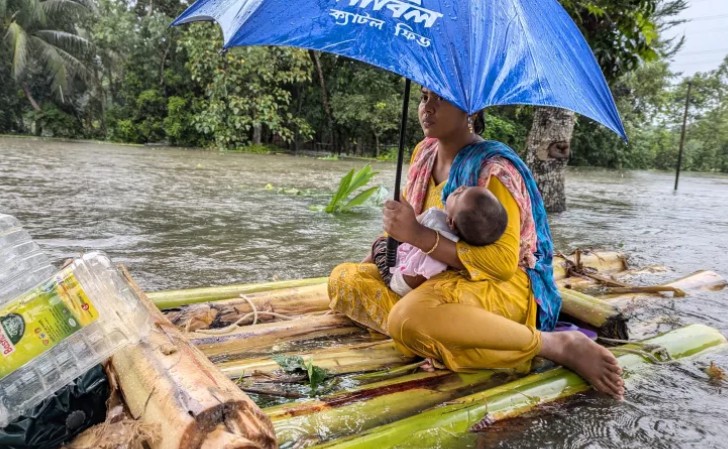
A disaster does not start when a cyclone hits the coast, or a river breaks its banks. It starts decades ago, when wetlands were reclaimed, forests and mangroves were cleared, rivers are impounded, embankments are ignored and poor communities have no guaranteed access to land, water and livelihoods.
Nor does it end once the water has ebbed away. The displaced families face homelessness, debts, interruption of education, unsafe migration, informal employment, poor health and loss of community, culture and ecological rootedness.
Disaster displacement should therefore be understood not just as a humanitarian emergency, but a violation of human rights, natural rights and development justice.
Bangladesh’s invisible displacement problem
The new IDMC-RMMRU report on “The Human Cost of Disaster Displacement in Bangladesh” highlights the extent of this problem. Between 2008 and 2025, there were approximately 21.3 million disaster displacements in Bangladesh, putting the country among the six most affected in the world. Almost all of the displacements (over 99 per cent) occurred due to weather-related hazards, such as cyclones and storms. There were about 11.3 million cyclones and storm displacements, and 7.8 million floods.
They represent displacements, not necessarily individual displacements. Communities may be displaced several times in the same year, losing assets, borrowing to recover and then being displaced again before full recovery.
Pre-emptive evacuations account for at least half of the recorded disaster displacements in Bangladesh. The country’s early warning systems and cyclone shelters have saved countless lives. Yet, even if a family survives a cyclone, they may come back to destroyed houses, saline agriculture fields, water contaminated with pollutants and livelihoods no longer available.
Losing life-years
The key novelty of the IDMC–RMMRU report is the introduction of a life-year approach. Unlike conventional approaches that quantify damages to roads, buildings and agricultural production, this approach quantifies the deterioration of the quality of people’s lives during displacement and recovery periods.
According to the report, 89,000 life-years have been lost between 2008 and 2025 in Bangladesh due to disaster displacement, representing a total welfare cost of approximately $1.7 billion or $102 million per year.
Cyclone Amphan in 2020 alone caused the loss of 9,500 life-years, equivalent to $184 million, whereas floods in the 2020 monsoon season caused 8,800 life-years lost, which equals $169 million.
Notably, almost 70 per cent of the human welfare cost was incurred due to small- and medium-scale events, which are hardly ever highlighted in international media or in the global disaster system. Riverine erosion, local flooding, water logging, soil salinity and storm surges may create more losses in human well-being than large-scale catastrophic events.
Environmental migration is not a future problem
According to the recent analysis by the World Bank Groundswell report, climate change may cause the internal migration of 216 million people in six world regions by 2050. According to this projection, 19.9 million Bangladeshis could become climate migrants by 2050 under the high-impact scenario.
These projections are not inevitable. Whether climate change becomes manageable migration or disaster-driven displacement will depend on governance, protection of ecosystems, land rights, investments and urban planning.
Migration can be empowering, as long as people are informed and have resources to migrate. They become forced displacements when people do not have control over where and when to migrate.
The crucial question is therefore not the sheer number of climate-induced movers, but who is being displaced, who could remain without risks and who bears the cost of displacement.
Gendering climate displacement
Change Initiative’s analysis of climate migration and female workers in Bangladesh illustrates that displacement is a gender issue.
Women who leave climate-affected areas for Dhaka usually lack education, skills, social connections and access to safe housing. They mostly become domestic helpers, informally employed in manufacturing or trade.
Migration can increase income in nominal terms. However, the costs of housing, food, transportation, healthcare and education are higher in urban areas. Women face harassment, insecurity, gender-based violence, lack of social protection and more unpaid work burden due to having children to take care of.
The data in IDMC–RMMRU report confirms this situation. Out of the sampled 1,467 poor households, only 381 were able to get out of the poverty trap due to increased income, whereas 20 per cent of the previously well-off families lost their incomes by 30 per cent and more.
Displacement does not just transfer poverty from rural to urban areas. It often aggravates it in a more costly and insecure environment.
The hazard led disaster is managed
The expression “natural disaster” often conceals the political responsibility. Cyclones are natural phenomena, and seasonal flooding is a part of a river’s natural cycle. Yet, the extent of destruction is determined by human decisions. Wetland clearance means losing natural water storage capacity. Deforestation speeds up runoff and erosion processes. River encroachments prevent the normal flow of water. Urbanization obstructs drainage systems. Fossil fuel emissions exacerbate climate risks. Land insecurity hinders rebuilding activities.
The hazard is natural, but the disaster is created
The effects of climate change will make such disparities even more acute. IDMC-RMMRU modeling shows that the human cost of riverine-flood displacement could rise to $176 million per year under the 5°C warming scenario. Under the same scenario, the human cost of storm surge displacements could rise to $186 million per year.
Global frameworks, including the UN Guiding Principles, Sendai Framework, UNFCCC Task Force on Displacement, Platform on Disaster Displacement and UN Action Agenda, promote prevention, protection and durable solutions. Yet governance remains fragmented, legally non-binding and inadequately financed. Most approaches manage displaced people after harm occurs but neglect enforceable protection for ecosystems whose destruction drives displacement. NRLG addresses this critical gap.
The Natural Rights Led Governance solution
Conventional disaster governance sees rivers, forests, wetlands and coasts as natural resources, whereas displaced people as recipients of relief. Natural Rights Led Governance, or NRLG, starts with a completely different understanding. Humans, communities and natural systems have interconnected rights to exist, regenerate and sustain themselves across generations.
When a mangrove is destroyed, the ecosystem loses its regenerative power, and the coastal population loses natural protection. When a river becomes polluted or blocked, the ecosystem integrity of the river suffers, and fishing communities lose food, work opportunities and culture.
Thus, displacement is the breakdown of the rights to life, land, water, livelihood, shelter, health, culture and community, as well as the rights of ecosystems and future generations.
NRLG proposes seven concrete steps to be taken below-
- Governments should protect life, habitats and property through combining hazard exposure, poverty, land tenure, health, gender inequality and environmental degradation in disaster risk management.
- Wetlands, rivers, mangroves, forests and flood plains should be considered protective natural infrastructure. Each major project planned in the vulnerable area should undergo a Natural Rights and Displacement Impact Assessment.
- Corporations, financiers and state agencies that pollute the environment and damage ecosystems should pay for the environmental damage, as well as restore the damaged ecosystems according to the principle “polluter pays”.
- Disaster response programs should prioritize women, children, landless families, informal workers, indigenous populations and repeatedly displaced communities. Social protection should remain portable even when people cross administrative borders.
- Local Natural Rights and Displacement Justice Councils should resolve conflicts over land, compensation, relocation and access to public goods, such as clean drinking water.
- Communities should be recognized as stewards of their ecosystems. River Keeper organizations, wetland guardians, water committees led by women and stewardship councils should receive legal, technical and financial support.
- Ecosystems must receive enforceable rights to exist, regenerate and maintain ecological flows. Conservation of natural rights is the surest protection of human rights to remain.
From relief to regenerative justice
There has been significant progress in recognizing climate-induced mobility in international frameworks: Sendai Framework, the UN Guiding Principles on Internal Displacement, the Warsaw International Mechanism Task Force on Displacement and the Platform on Disaster Displacement. However, the system is fragmented and insufficiently financed.
It provides more money to deal with consequences of disasters than for prevention of disaster displacement. It finances emergency response faster than rehabilitation, reforestation, safe housing or livelihood recovery. Poor developing countries, who contribute the least to climate change, are expected to borrow money to cope with the consequences of it.
Finance for dealing with climate displacement should therefore be grant-based, additional and easily accessible by the communities and local governments, not just by national governments.
It should recognize life-years lost, unpaid care work, ecological damage and cultural displacement, not only the damage to physical infrastructure.
Bangladesh has demonstrated that early warning can prevent mortality in the disasters. The next challenge is to ensure that survival is not followed by years of poverty and displacement.
The person saved from a cyclone but forced to live in unsafe housing, exploitative working conditions and unable to return to her homeland is not a survivor, she is a victim of disaster.
The goal of global disaster governance should therefore be simple: to protect the right to remain, the right to migrate safely when necessary and the right of nature to regenerate.
The views expressed in this article are the author’s own and do not necessarily reflect Sarabangla English Edition’s editorial stance.