


 Play store

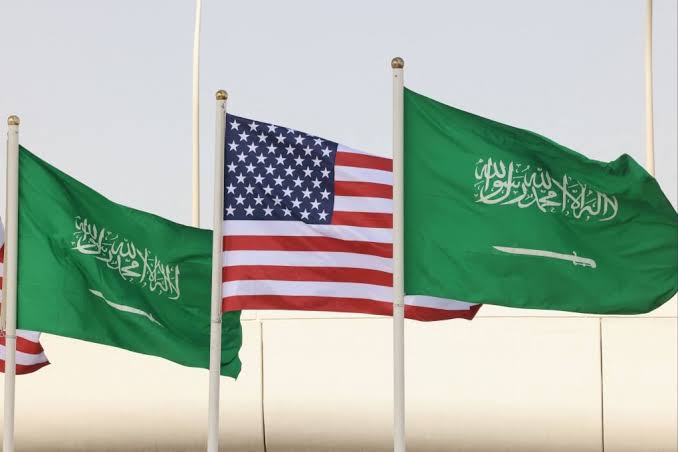
Just a day after the United States and Saudi Arabia signed a long-awaited civilian nuclear cooperation agreement, President Donald Trump introduced new conditions that have thrown the deal into uncertainty.
The agreement, signed on Wednesday at the U.S. Department of Energy headquarters after nearly two decades of negotiations, was initially presented as a major breakthrough in bilateral relations. U.S. Energy Secretary Chris Wright attended the ceremony in Washington, while his Saudi counterpart joined via video link from Riyadh.
Trump’s Sudden Change of Position
On Thursday morning, Trump announced on his social media platform, Truth Social, that the agreement would only move forward if Saudi Arabia joins the Abraham Accords, the U.S.-brokered normalization framework under which several Arab nations established diplomatic relations with Israel during Trump’s first term.
He also declared that Saudi Arabia would not be allowed to enrich uranium under the agreement—a significant clarification that was not publicly emphasized during the signing ceremony.
Internal Dispute Inside the Administration
According to CNN, Trump was already unhappy before the agreement was announced. A source familiar with the matter said Energy Secretary Chris Wright did not inform the president that the deal would be unveiled that day.
Trump’s frustration reportedly intensified after conservative media outlets, including Fox News and The Wall Street Journal editorial board, criticized the agreement for lacking a requirement that Saudi Arabia normalize relations with Israel. Critics noted that former President Joe Biden had also sought to link a similar nuclear deal to Saudi recognition of Israel.
White House Blames Energy Department
As controversy grew, White House officials reportedly shifted responsibility to the Department of Energy. One source said the White House had wanted the announcement postponed, but Wright proceeded with the ceremony and later discussed the agreement in a Fox Business interview.
Several administration officials argued that the agreement had not yet been formally finalized because the required documentation had not been submitted to Congress. They viewed the public announcement as premature, angering Trump and his senior advisers.
White House spokesperson Taylor Rogers later stated that Saudi Arabia’s participation in the Abraham Accords has always been a condition for the nuclear agreement, insisting that Trump’s energy team fully supports that position.
Energy Department Rejects the Claims :The Department of Energy denied any lack of coordination. Spokesperson Ben Dietderich said the department worked closely with both the White House and the State Department throughout the negotiations and the announcement process.
He added that both the civilian nuclear agreement and the Abraham Accords are intended to promote lasting peace in the Middle East through economic cooperation rather than conflict.
A Deal Years in the Making: The civilian nuclear agreement is the culmination of nearly 20 years of negotiations between Washington and Riyadh. Last October, the two countries announced they had reached a preliminary understanding.
The Trump administration later submitted a waiver-related report to Congress because the agreement does not require Saudi Arabia to adopt the International Atomic Energy Agency’s (IAEA) Additional Protocol, which provides for more extensive international inspections.
CNN previously reported that concerns over the conflict with Iran and potential opposition in Congress delayed Trump’s approval of the agreement.
According to one source, Energy Department officials believed they had received presidential approval before preparing the announcement. However, another source claimed Trump had only approved a preliminary understanding—not the public declaration of a final agreement.
Trump’s subsequent demand for Saudi Arabia to join the Abraham Accords and his insistence on banning uranium enrichment have now introduced fresh uncertainty over the future of the landmark nuclear deal.