


 Play store

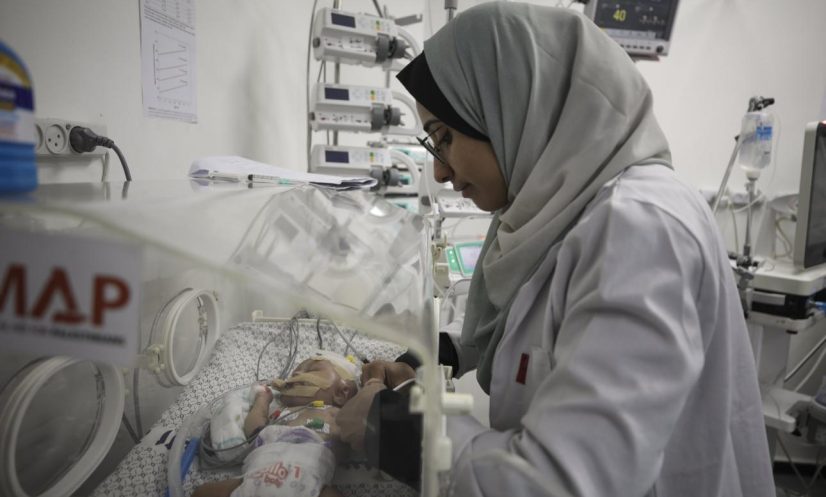
In a dimly lit neonatal unit in the central Gaza Strip, rows of incubators hum softly—each one holding a life that arrived too early into a world already overwhelmed by war.
Thirty-year-old Noor Salem stands quietly beside one of them, her eyes fixed on her newborn son, Yazan Al-Khalidi. Separated by glass and a web of tubes, she watches every breath he struggles to take.
Yazan was born in the eighth month of pregnancy—small, fragile, and unable to breathe on his own. Within moments of birth, he was rushed into intensive care at Al-Aqsa Martyrs Hospital.
Instead of holding her child, Noor now waits—day after day—for signs of improvement.
“I was terrified throughout my pregnancy,” she says quietly. “When he didn’t cry, I thought I would lose him too.”
Her fear is not unfounded. Noor had already lost a child during the famine that gripped Gaza in 2025—one of many crises worsened by ongoing conflict.
A Growing Crisis of Early Births
Since the escalation of violence in October 2023, doctors across Gaza have reported a sharp rise in premature births, underweight infants, and stillbirths.
UNICEF warns that nearly one in five newborns now requires intensive or specialized care—an alarming figure in a health system pushed to its limits.
Medical experts point to a combination of factors: chronic malnutrition, psychological stress, displacement, and the collapse of prenatal healthcare services.
Dr. Afnan Abu Hasaballah, an obstetrician working with UNRWA, describes the conditions faced by pregnant women:
“Many arrive exhausted—displaced multiple times, lacking food, clean water, and access to care. These are direct triggers for premature labor.”
Hospitals Under Pressure
At Al-Aqsa Martyrs Hospital—the only facility with a neonatal unit in central Gaza—resources are dangerously scarce.
Doctors struggle with shortages of incubators, ventilators, medication, and even electricity. Power cuts and fuel shortages threaten the very babies fighting for survival inside life-support machines.
“We are working beyond capacity,” says Dr. Hasaballah. “Sometimes, we lose babies who could have survived with basic care.”
Premature infants require constant monitoring, oxygen, warmth, and nutrition—needs that are increasingly difficult to meet in a strained healthcare system.
Mothers Without Arms to Hold Their Children
For many mothers, the trauma goes beyond medical concerns. The immediate separation after birth—babies taken straight to incubators—creates a deep emotional wound.
“Instead of joy, there is fear,” says Dr. Hasaballah. “The first question every mother asks is: ‘Will my baby survive?’”
Life After Discharge: Another Battle
Even when babies leave the hospital, survival remains uncertain.
Families—many displaced and stripped of everything—struggle to find basic necessities: baby formula, clean water, clothing, and medicine.
Organizations like the Qutoof Al-Khair Foundation are trying to fill the gap, providing vitamins, supplements, and medical aid to mothers and children.
But demand far outweighs supply.
“Every day, the needs grow,” says Akram Abu Jiab, head of the foundation. “We cannot keep up.”
A Generation at Risk
Behind each premature birth in Gaza lies a larger story—of war, deprivation, and resilience.
These newborns are not just fighting medical complications; they are fighting circumstances beyond their control.
“Supporting mothers and children is not a luxury,” Abu Jiab says. “It is essential to protect the next generation.”
For Noor, the future is measured in small victories—a steady breath, a slight movement, a doctor’s hopeful update.
And above all, the hope that one day, she will finally hold her son in her arms.