


 Play store

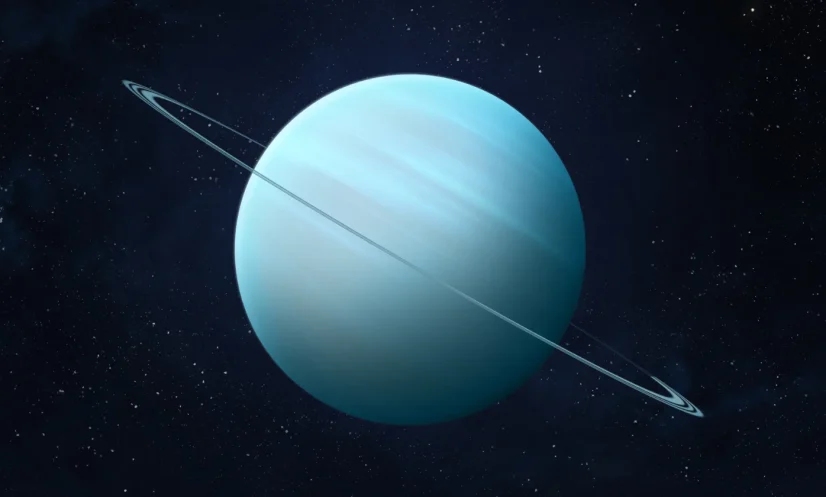
WASHINGTON: Uranus experiences the most extreme seasons in the solar system, with each of its poles enduring 42 years of continuous daylight followed by 42 years of uninterrupted darkness—a phenomenon caused by the planet’s extraordinary axial tilt.
Unlike Earth, which is tilted by about 23.4 degrees and experiences four distinct seasons, Uranus is tilted by approximately 97.8 degrees, causing it to rotate almost on its side as it orbits the Sun. Instead of spinning like a top, the ice giant rolls around the Sun, exposing one pole to constant sunlight while the other remains in darkness.
The planet completes one rotation every 17 hours, but that rapid spin has little effect on sunrise and sunset at the poles. Instead, its 84-year journey around the Sun determines when each pole experiences day or night.
According to researchers at the Space Science and Engineering Center at the University of Wisconsin-Madison, Uranus’s unusual orientation means its poles alternate between 42 years of sunlight and 42 years of darkness, giving the planet the most extreme seasonal cycle in the solar system.
Scientists had long expected such prolonged exposure to sunlight to trigger dramatic atmospheric changes. However, observations have shown that Uranus’s atmosphere responds much more slowly and unpredictably than expected. Researchers believe the planet’s frigid atmosphere—where average temperatures hover around minus 195 degrees Celsius—absorbs and releases heat very slowly, delaying seasonal changes.
Despite its scientific importance, Uranus remains one of the least explored planets. NASA’s Voyager 2 remains the only spacecraft to have visited the planet, flying past it in 1986 and capturing only a brief snapshot of its 84-year seasonal cycle.
Scientists believe Uranus’s unusual tilt was most likely caused by a colossal collision early in the solar system’s history. Computer simulations led by Jacob Kegerreis suggest the young planet may have been struck by an object at least twice the mass of Earth, knocking it onto its side.
However, researchers caution that the giant-impact theory remains a leading hypothesis rather than a confirmed explanation. An alternative study published in 2022 proposed that Uranus’s tilt could have developed gradually through long-term gravitational interactions involving the still-hypothetical Planet Nine.
Whether caused by a catastrophic collision or a slow gravitational process, Uranus continues to puzzle scientists with one of the solar system’s most extraordinary features—decades-long days and nights unlike anything seen on any other planet.