Play store

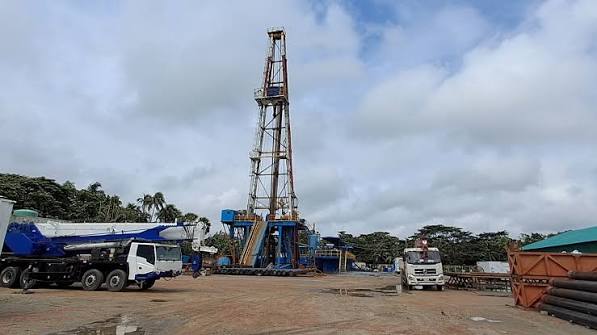
Bangladesh Petroleum Exploration and Production Company Limited (Bapex) has begun drilling a new gas well in Noakhali as the country steps up efforts to boost domestic natural gas production amid an acute supply shortage that has disrupted households, industries and power generation.
The state-owned exploration company formally inaugurated the Sundalpur-4 Evaluation-cum-Development Well Drilling Project on Tuesday afternoon, with full-scale drilling operations commencing on Wednesday at Boro Charigaon village under Nabipur Union in Senbagh upazila.
If drilling and subsequent testing are successful, the well is expected to produce around 7 million cubic feet of natural gas per day (mmcfd), providing a modest but timely addition to the national gas grid at a time when Bangladesh is struggling to meet rising energy demand.
According to Bapex officials, the drilling programme will continue for approximately 45 days, followed by a 15-day Drill Stem Test (DST) to determine the commercial viability and reserve size of the field.
Zakir Hossain Khan, drilling in-charge of the Sundalpur-4 project, said the well has a target depth of 1,550 metres, with gas-bearing formations expected at depths of 1,361 metres and 1,450 metres.
The project is being carried out using directional drilling technology combined with Measurement While Drilling (MWD), enabling engineers to collect real-time geological data and improve drilling accuracy.
Officials said the Sundalpur-4 project is both an evaluation and development well, designed to assess the field’s remaining reserves while expanding production if commercially viable.
The latest drilling initiative comes as Bangladesh faces one of its worst gas supply disruptions in recent years following a fire at a floating Liquefied Natural Gas (LNG) terminal off Cox’s Bazar last week.
The incident sharply reduced imported LNG supplies, triggering widespread gas shortages in Dhaka and several other parts of the country. The disruption has affected household cooking, forced many industries to cut production, reduced electricity generation and created long queues at compressed natural gas (CNG) filling stations.
Energy experts say increasing domestic gas production has become increasingly important as Bangladesh seeks to reduce its dependence on costly imported LNG while ensuring energy security.
Noakhali has a long history of hydrocarbon exploration. According to Bapex records, the area’s first gas well was discovered in Begumganj in 1976, followed by another discovery in 1978. However, neither well produced commercial quantities of gas.
A breakthrough came in 2013 when a third well was successfully drilled and later brought into production. Following a workover in 2018, the well currently supplies around 8 mmcfd of natural gas to the national grid.
Bapex has also drilled three wells under the Sundalpur field, namely Sundalpur-1, Sundalpur-2 and Sundalpur-3. Of these, Sundalpur-2 remains in production, while output from Sundalpur-1 and Sundalpur-3 has been suspended. Officials said production from Sundalpur-3 is expected to resume after ongoing workover operations are completed.
The new Sundalpur-4 well is expected to strengthen the production capacity of the field and contribute to the government’s broader strategy of increasing domestic gas output through intensified exploration and development activities.
Although the projected production of 7 mmcfd would represent only a small fraction of Bangladesh’s daily gas demand, officials believe every additional supply is crucial at a time when the country continues to face mounting pressure from growing industrial demand, declining output from mature gas fields and rising import costs.
The government has repeatedly emphasised expanding domestic exploration alongside LNG imports to ensure a more secure and sustainable energy supply, with Bapex playing the lead role in discovering and developing new gas reserves across the country.