


 Play store

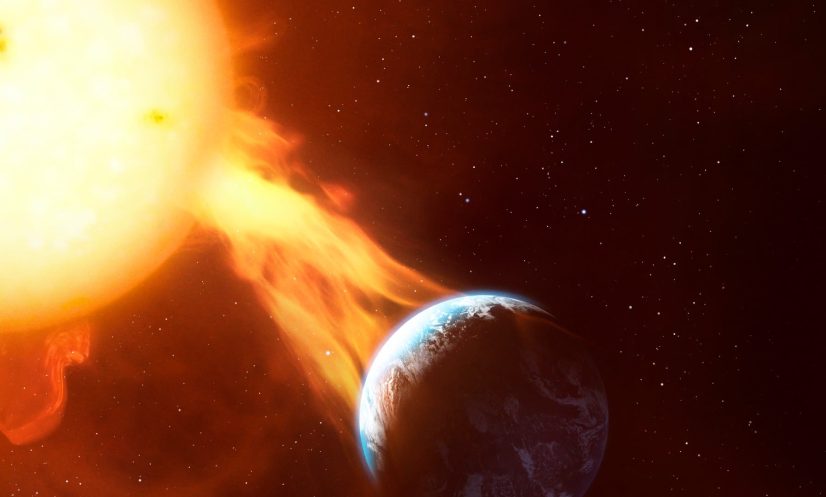
WASHINGTON: More than 165 years ago, the most powerful solar storm ever recorded transformed skies across the world, disrupted telegraph networks and provided the first clues that violent activity on the Sun could directly affect Earth.
Known today as the Carrington Event, the historic space weather event began on September 1, 1859, when English astronomers Richard Carrington and Richard Hodgson independently observed brilliant flashes of white light erupting from a large sunspot group on the Sun.
About 17 hours later, in the early hours of September 2, an exceptionally powerful geomagnetic storm struck Earth.
The effects were dramatic. Brilliant red and green auroras illuminated skies far beyond the polar regions, reaching as far south as Cuba, the Caribbean, Central America and parts of South America—areas where such displays are rarely, if ever, seen.
The storm also wreaked havoc on 19th-century communications. Telegraph systems across Europe and North America experienced electrical surges that produced sparks, shocked operators and disrupted normal operations.
One telegraph line between Boston and Portland, Maine, became particularly famous. After disconnecting their batteries, operators discovered they could continue sending messages for nearly two hours using electricity induced by the geomagnetic storm itself. Scientists later explained that rapid changes in Earth’s magnetic field had generated electric currents in the long grounded telegraph wires.
At the time, researchers had little understanding of the connection between solar activity and Earth’s magnetic environment. Although Carrington and Hodgson documented the rare white-light solar flare, they could not explain how it triggered the disturbances observed on Earth.
Modern science has since identified the event as the result of a massive coronal mass ejection (CME)—a huge cloud of magnetized plasma expelled from the Sun. Unlike a beam of individual particles, a CME is a vast structure of charged gas and magnetic fields. Its impact depends not only on its speed but also on the orientation of its magnetic field when it reaches Earth.
Most CMEs take several days to travel the roughly 150 million kilometers separating the Sun and Earth. However, researchers estimate the Carrington Event reached Earth in only about 17 hours, making it one of the fastest and most powerful solar eruptions ever recorded.
Scientists believe an earlier solar eruption may have cleared the path through the solar wind, allowing the later CME to travel with unusually little resistance.
Auroras occur when charged particles from the Sun interact with Earth’s magnetic field and collide with oxygen and nitrogen atoms high in the atmosphere, causing them to emit light. During exceptionally strong geomagnetic storms, the auroral zones expand far toward the equator, producing dazzling displays in regions that rarely witness the phenomenon.
Researchers note that the famous Carrington Event was not an isolated eruption. Historical records indicate that multiple solar eruptions and geomagnetic storms occurred between late August and early September 1859, including another major auroral display on August 28–29.
Today, the Carrington Event remains the benchmark for extreme space weather. Scientists continue to study it to better understand the potential risks that a similar solar storm could pose to modern satellites, power grids, communications systems and global navigation networks.