Play store

Bangladesh must pursue meaningful democratic reform, institutional accountability and inclusive political participation to fulfil the aspirations of the July mass uprising, speakers said at a dialogue in Dhaka on Saturday.
They stressed that reform cannot be limited to constitutional amendments or changes in government, but must extend to state institutions, the judiciary, police, bureaucracy, Parliament, local government and political culture.
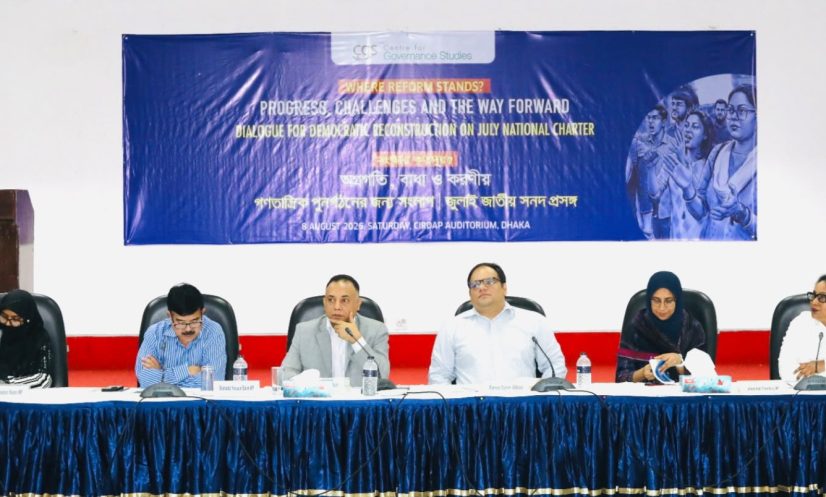
The remarks came at a dialogue titled “Where Reform Stands? Progress, Challenges and the Way Forward”, organised by the Centre for Governance Studies (CGS) under its Reform Watch initiative at the CIRDAP Auditorium.
The event presented the findings of a mid-term report on the implementation of the July National Charter and brought together lawmakers, political leaders, civil society representatives, academics, journalists, lawyers and representatives of different political parties.
CGS President Zillur Rahman moderated the discussion.
Opening the event, Zillur Rahman said reform was an ongoing process, although people often expected everything to be accomplished at once.
“Democratic reconstruction and democracy are fundamentally matters of broader political culture and continuous practice,” he said.
He observed that a good election had been held, although after a prolonged period of political uncertainty, some people might still not consider the process fully satisfactory.
BNP lawmaker Shahadat Hossain Selim said there were notes of dissent on 16 of the 84 issues covered by the reform process, although not all of those dissenting positions came from the BNP.
He argued that some commission proposals had been framed in a way that left the BNP “trying to swim with its hands and feet tied”.
The necessary reforms, he said, would ultimately have to be implemented by an elected government.
He highlighted women’s political representation as one of the most extensively discussed issues, referring to proposals for 50 reserved parliamentary seats for women and another 50 seats to be filled through direct elections.
Selim said constitutional amendments should be considered by a special committee after extensive discussion and consultation with stakeholders.
BNP lawmaker Jahrat Adib Chowdhury said corruption, violence against women, unemployment and inequality remained major challenges.
She called for continued dialogue between the government and opposition, greater transparency and accountability within the bureaucracy, and greater political tolerance among young people.
Eleven Party Alliance lawmaker Tasmia Prodhan said structural reform was essential following the mass uprising. She described the failure to administer the oath of the Reform Council and the lack of progress on several reform initiatives as disappointing.
Her alliance colleague Subikunnahar Munni said democracy meant more than holding elections. Rule of law, accountability and inclusive state reform were equally important, she said, calling for a political culture that ensures safe and meaningful participation of women.
Former International Crimes Tribunal Chief Prosecutor Advocate Muhammad Tajul Islam said fundamental and structural reforms were necessary to fulfil the aspirations generated by the July uprising.
He said public support for reform and a degree of political consensus had been reflected in the July Charter and referendum, and warned that ignoring the process could increase public frustration.
Reform, he said, should extend beyond constitutional amendments to bring meaningful changes to state institutions while respecting the people’s mandate.
Tajul also called for accountability in implementing important ordinances and urged reform of the police’s longstanding repressive mindset and weaknesses in its investigative system.
Jatiya Party Secretary General Barrister Shameem Haider Patwary said the July movement had created a major opportunity for reform, but political interests had subsequently weakened the consensus.
He suggested that existing parliamentary committees could consult all political parties and enact key elements of the July Charter through legislation.
He said expected progress had not been made in areas including judicial independence, judicial appointments and strengthening the Human Rights Commission. He also called for the establishment of an upper house and fundamental police reform.
BSD Joint General Secretary Razekuzzaman Ratan called for mechanisms to prevent excessive concentration of power. He said the president should have an effective role in key appointments while the government must remain accountable to Parliament.
He also called for greater political participation by women, freedom of the police from political influence and protection of local government institutions from excessive administrative control.
JSD General Secretary Nazmul Haque Prodhan said Bangladesh had yet to develop a culture of political tolerance. Transfers of power had repeatedly occurred through conflict, he said, without producing the democratic transformation people expected.
He called for a more effective Parliament and greater political tolerance, saying Bangladesh could potentially become a positive example at a time when democracy is facing challenges worldwide.
CGS Executive Director Parvez Karim Abbasi stressed that public opinion must be prioritised in the reform process. He called for bureaucratic reform, stronger checks and balances, greater accountability and meaningful representation of women.
AB Party leader Barrister Nasreen Sultana Mily said areas of the July Charter where political consensus already exists should be implemented without unnecessary delay. She stressed institutional reform and a balance of power among the judiciary, police and media.
CPB Presidium Member Joly Talukder said the reform agenda associated with July could not be separated from the country’s Liberation War and called for substantive political participation of women and policies that protect the interests of ordinary and working-class people.
Rashtro Songskar Andolon representative Lamia Islam said women had consistently played important roles during national crises and therefore deserved meaningful participation in policymaking. She also stressed constitutional reform, decentralisation and stronger mechanisms of accountability.
Khelafat Majlis Organising Secretary Professor Kazi Minhazul Alam called for an end to the colonial mindset within the police administration and effective measures to ensure women’s representation.
Journalist Sohrab Hassan said political decisions should be reached through dialogue to protect fundamental rights and build an inclusive democracy. He also called for stronger local government and greater women’s participation in politics.
Bangladesh Indigenous Peoples Forum General Secretary Sanjeeb Drong urged the state to ensure equal opportunities, dignity and political representation for ethnic communities, along with protection of their languages and cultures.
Senior jurist and former Constitutional Reform Commission member Dr Sharif Bhuiyan said constitutional and state reforms must be participatory. Without meaningful implementation and a change in political culture, he warned, the old system would simply continue.
North South University Professor of Political Science and Sociology Dr Bulbul Siddiqi called for a clear, priority-based reform roadmap. Politicalisation and excessive concentration of power must be reduced, while accountability, local government and public trust in state institutions must be strengthened, he said.
NCP Joint Convener Sarwar Tusher said inconsistencies in political positions on the referendum and reform before and after the election could frustrate the public. He stressed that political parties must fulfil their commitments and demonstrate responsible behaviour to prevent future conflict.
The discussion underscored a broad consensus among participants that Bangladesh’s post-July transition requires more than a change of political leadership. Speakers repeatedly stressed that lasting democratic transformation will depend on institutional reform, accountability, political tolerance, inclusion and sustained public participation.