


 Play store

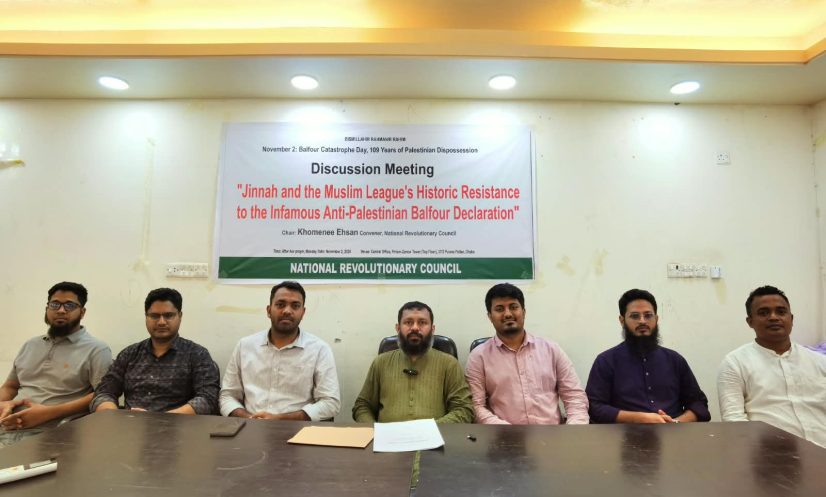
Dhaka: Speakers at a discussion marking the 109th anniversary of the Balfour Declaration have said that the historical position taken by Muhammad Ali Jinnah and the Muslim League on the Palestine issue influenced the pro-Palestinian policies of Pakistan and Bangladesh. In keeping with that position, neither country has recognised Israel to date.
The discussion, titled “Jinnah and the Muslim League’s Historic Resistance to the Notorious Anti-Palestinian Balfour Declaration”, was organised by the Muslim nationalist party Jatiya Biplabi Parishad at its central office in Purana Paltan in the capital on Monday afternoon.
The event was chaired by the party’s convener, Khomenei Ehsan, and moderated by its member secretary, Dr Nabil Ahmed.
Among those who spoke were history researchers Yusuf Sharif, Abdus Salam, Saidul Islam, Abdul Wahed, Fazlur Rahman and Ariful Islam.
On November 2, 1917, British Foreign Secretary Arthur James Balfour wrote a letter to Zionist leader Lord Rothschild expressing the British government’s support for the establishment of a “national home for the Jewish people” in Palestine.
The speakers described the declaration as illegitimate, saying it laid the foundation for the eventual establishment of the state of Israel.
According to the speakers, Jinnah had consistently opposed the Balfour Declaration since 1934 and supported an independent Palestine.
They said Pakistan, shortly after its establishment in 1947, described the declaration as illegitimate at the United Nations and rejected a proposal to establish two separate states, Palestine and Israel.
The speakers said this position was reflected in the inclusion of the words “Except Israel” in Pakistani passports. Bangladesh also included the same wording in its passports after emerging as an independent country in 1971. Although the phrase was removed in 2021, the government later directed that it be reinstated, they added.
In his presidential address, Khomenei Ehsan analysed the text of the Balfour Declaration, saying it made no mention of Palestine’s Arab majority population. Instead, they were referred to merely as “non-Jewish communities”, with only their civil and religious rights recognised, while a “national home” was promised to the Jewish people.
He said Britain had no legitimate authority over the land to offer it to another people, making the declaration unacceptable from both legal and moral perspectives. Balfour himself acknowledged in a 1919 memorandum that no formal consultation was being held to seek the views of the people living in Palestine, he added.
Ehsan further said that from 1934 to 1940, Jinnah and the Muslim League had consistently supported the Palestinians through League Council resolutions, the Lucknow and Patna sessions, observance of Palestine Day and the Lahore session.
Emphasising that the principle of self-determination, which had led Muslims of the Indian subcontinent to seek control over their own destiny, should apply equally to the Palestinians, he called for remembering history and standing on the side of justice.