


 Play store

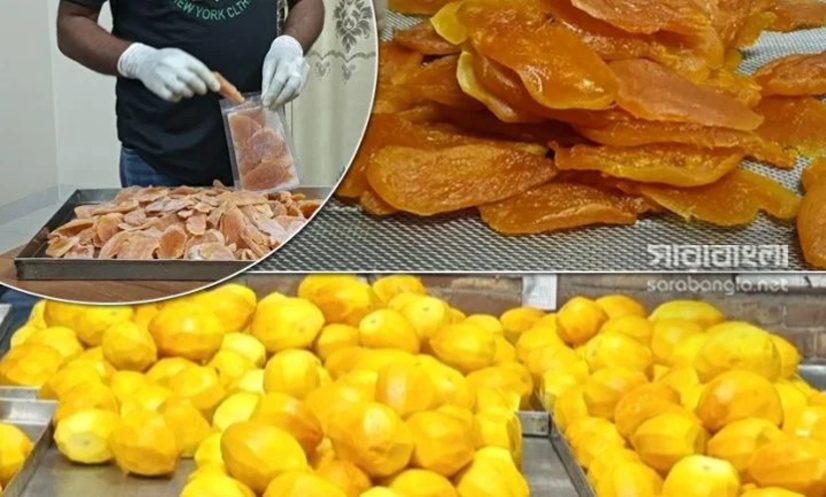
Chapainawabganj, known as Bangladesh’s mango capital, is turning surplus and overripe mangoes into a promising value-added food product as a young entrepreneur seeks to reduce waste and create new opportunities for farmers and the local economy.
Every summer, mango orchards across the district become laden with the juicy fruit, much of which is shipped to different parts of Bangladesh and overseas. But after the peak season, large quantities of mangoes are either sold at very low prices or left to spoil because of excess ripening and declining market demand.
Entrepreneur Ismail Khan Shamim of Shibganj upazila is now giving those mangoes a new lease of life through a dried mango processing initiative. His goal is not only to sell the product in the domestic market but eventually establish dried mango as a “Made in Bangladesh” product in international markets.
Shamim said he had witnessed mango wastage since childhood. His family has been involved in the mango trade for three generations, and he saw how good-quality mangoes often lost their value toward the end of the season because they became overripe.
His interest in dried mango grew after a visit to Thailand in 2022, where he learned about the product’s potential market. After returning home, he began conducting research and experiments before eventually setting up a dried mango processing unit at his home with technical assistance from Switzerland-based development organisation Swisscontact.
Following extensive trials, the facility is now producing more than 100 kilograms of dried mango a day.
The production process begins with mangoes collected from orchards and local markets. The fruit is thoroughly washed and cleaned before being peeled and cut into specific sizes. The pieces are then dried in a temperature-controlled dehydrator for between 12 and 18 hours before being vacuum-packed for marketing.
According to Shamim, the product is made without artificial preservatives and can remain edible for an extended period when properly stored. This creates an opportunity to overcome the traditional limitation of mango sales being concentrated within only a few months of the year.
The initiative is also providing a new market for local farmers. Mangoes that previously fetched very low prices at the end of the season can now be sold to the processing unit, turning what was once a source of losses into an additional source of income.
The processing venture is also creating employment opportunities for local workers whose jobs traditionally decline after the mango season ends. Local entrepreneurs and stakeholders believe that expanding such small and medium-sized processing businesses could help establish a new mango-based industrial sector in Chapainawabganj.
Shamim hopes to eventually export his dried mango to international markets.
“Our goal is to produce a completely natural, quality product that can meet the demands of international markets. We dream of taking this product to different countries around the world under the ‘Made in Bangladesh’ identity,” he said.
He believes processed mango products could make a significant contribution to the national economy if entrepreneurs receive adequate support from both the government and private sector.
However, industry expansion faces several challenges, including access to affordable financing, international-standard packaging, food safety certification, modern cold storage, advanced processing technology and export-friendly policies.
Officials of the Department of Agricultural Extension say a number of young entrepreneurs in Chapainawabganj have already begun exploring new businesses based on mangoes.
Mohammad Atikul Islam, deputy director of the Department of Agricultural Extension in Chapainawabganj, said the department was providing support to young entrepreneurs seeking to develop mango-based businesses.
“Several young entrepreneurs have emerged in the district. The department is supporting them. Instead of viewing mangoes only as fresh fruit, entrepreneurs are taking initiatives to develop processing industries. If these initiatives succeed, they could open a new door for mango-based industries in Chapainawabganj,” he said.
A large part of Chapainawabganj’s economy revolves around mango production and trade. But dependence on fresh mango sales leaves farmers and traders heavily dependent on seasonal income.
The expansion of products such as dried mango, juice, pulp and pickles could help change that situation by extending the economic value of mangoes throughout the year.
Mangoes that once lost their value after becoming overripe could eventually become a source of foreign exchange earnings. With farmers’ production, entrepreneurial innovation and modern technology working together, Chapainawabganj could evolve from simply being Bangladesh’s “mango capital” into a major hub for mango-based processing.
Shamim’s dried mango venture offers a glimpse of that possibility. What began as a small local initiative could eventually take Chapainawabganj’s mangoes to Europe, the Middle East and other international markets—not merely as fresh fruit, but as a promising Bangladeshi export product.