


 Play store

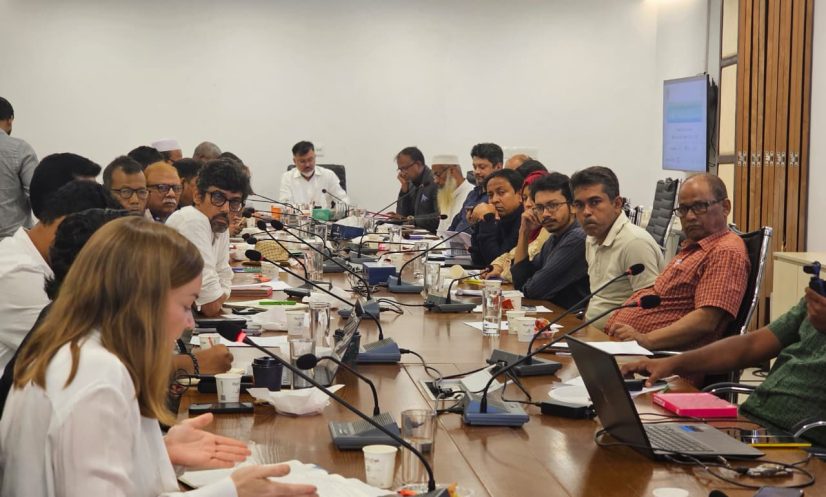
Dhaka North City Corporation (DNCC) Administrator Md. Shafiqul Islam Khan Milton has called for a unified, policy-driven approach to urban wetland restoration, suggesting that a current community-led pilot project could serve as a blueprint for the entire nation.
Speaking as the chief guest at a “Knowledge Exchange” event held at the DNCC auditorium, he highlighted the successes and challenges of the ReWET (Climate Impacted Dwellers-Led Agro-ecological Stewardship for Restoring Wetlands) project.
The initiative, a joint effort between River & Delta Research Consultants (RDRC) and DNCC, focuses on the ecological recovery of Gulshan-Banani Lake through the active participation of local community members and the involvement of researchers and academics from national and international universities.
The DNCC Administrator emphasised that the ReWET project is uniquely positioned to succeed because it is deeply rooted in the daily lives and livelihoods of the local community.
He noted that many residents depend on the lake for their sustenance and farm-related activities, making them natural stewards of the environment. “If implemented correctly and expanded, the ReWET model can stand as an effective model for the entire country in restoring urban wetlands,” the Administrator stated.
Despite his optimism, Milton was candid about the administrative hurdles facing such ambitious ecological projects. He specifically pointed to a persistent lack of coordination among various government agencies, including RAJUK and Dhaka WASA, and city corporations. He observed that project implementation often suffers when relevant organisations fail to attend coordination meetings or provide the necessary cooperation.
To remedy this, the DNCC Administrator emphasised the need for coordination at the policy level to ensure all stakeholders are aligned with the city corporations. He argued that without a synchronised effort from all governing bodies, the long-term sustainability of the lake’s restoration remains at risk.
He called for rigorous, ongoing evaluations of the lake’s water quality to ensure it is safe for the public. He also stressed that ecological restoration must not come at the cost of public health, specifically highlighting the need to research whether lake-based activities contribute to the spread of mosquito-borne diseases such as dengue.
“We must ensure that as we bring nature back to the city, we are also protecting the health of our citizens,” Milton said, adding that DNCC is committed to providing all necessary support to overcome these challenges and ensure the project’s success.
He assured that DNCC would remain a primary partner in these efforts, aiming to transform Gulshan-Banani Lake into a sustainable ecological treasure for the capital.
The event featured a keynote presentation by Imadul Haque, Co-Lead of ReWET and Assistant Professor at Smith College, USA. He observed that the project is an evidence-based urban restoration model that simultaneously addresses ecological and social challenges through community participation.
He detailed technical interventions, such as a 150-foot semi-circular bamboo structure and floating platforms supporting 23 types of experimental vegetation, which have successfully created new ecological habitats for fish, birds and beneficial insects.
Mohammad Aminur Rasul, Treasurer of River & Delta Research Consultants Limited (RDRC), observed that the project has successfully brought life and nature back to the Gulshan-Banani area, resulting in positive environmental changes. He remarked that if DNCC takes full ownership of the initiative, it can be scaled nationwide rather than being limited to one area, provided there is a unified effort from both government and private organisations.
Providing a global perspective, Beth Downe, Programme Manager at the International Institute for Environment and Development (IIED), UK, observed that the level of collaboration among diverse stakeholders in the ReWET project is incredible and highly commendable. She noted that the positive attitude of all involved parties will play a crucial role in the project’s future success.
ASM Marjan Nur, Representative of UKFCDO, Bangladesh, observed that the project has already exceeded initial expectations in terms of scale. He expressed optimism that the model can be scaled up even further in the future and suggested that DNCC work in closer coordination with UKFCDO to achieve larger climate goals, noting that Bangladesh requires approximately $235 million for effective climate action.
Addressing technical queries from Muhammad Asaduzzaman, Chief Executive Officer of DNCC, Shuvashish Das Shuvu, Consortium Coordinator of the ReWET Project, observed that quarterly water quality assessments had been conducted throughout 2024 and 2025.
He announced that further tests are underway to check for heavy metals in the lake’s soil, vegetables grown on floating platforms and the fish population, with results expected to be shared with DNCC within two weeks.
The session, chaired by Brigadier General Syed Rakibul Hasan, Chief Engineer of DNCC, concluded with a call for sustained inter-agency cooperation to ensure the long-term sustainability of the capital’s vital wetlands.
Rafiqul Islam Azad, former president of Dhaka Reporters Unity, Md Shaheduzzaman Shyamal, mentor of Nagar Abad, and Kazi Akif, former project manager of ReWET, among others, also spoke at the meeting, which was moderated by Asif Moinur Chowdhury, Project Manager of ReWET.