


 Play store

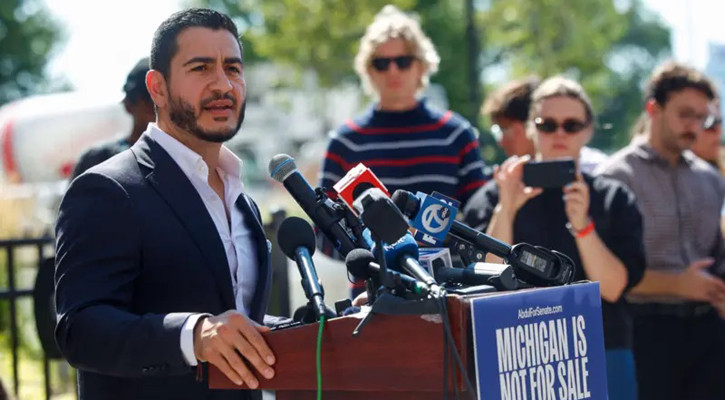
Abdul El-Sayed, a 41-year-old physician and progressive Democrat of Egyptian descent, has emerged as one of the most talked-about figures in US politics after securing the Democratic nomination for the US Senate in Michigan.
El-Sayed made history by becoming the first Muslim nominated by a major US political party for a US Senate seat.
His victory in the Democratic primary came as a surprise, as he narrowly defeated establishment-backed Rep. Haley Stevens in a fiercely contested race.
His political journey is not new. El-Sayed first gained national attention in 2018, when he ran for governor of Michigan as a progressive Democrat.
Although he lost that race, he received more than 30 percent of the vote, establishing himself as an important figure on the party’s progressive left.
Born to Egyptian immigrant parents, El-Sayed has spoken about how his family’s migration shaped his identity.
His father came to Detroit from Egypt, while El-Sayed went on to become a physician and public-health expert. He later served as Detroit’s health director.
His 2026 Senate campaign has focused on issues including universal healthcare, reducing the influence of money in politics and ending US military support for Israel.
His positions have attracted progressive voters but have also made him a target of fierce criticism from Republicans and some Democratic establishment figures.
El-Sayed’s primary victory was particularly notable because groups supporting his main opponent reportedly spent more than $60 million in the race.
Despite the huge spending advantage enjoyed by his rival, El-Sayed prevailed through an extensive grassroots campaign that included hundreds of events and thousands of volunteers.
His victory has also drawn attacks from President Donald Trump and other Republicans, particularly over his views on Israel and his Muslim identity.
El-Sayed has rejected such attacks, saying he wants Jewish Americans to enjoy the same security he wants for his own family.
Now, El-Sayed faces Republican candidate Mike Rogers in the November 2026 Senate election. The contest could be crucial because control of the US Senate may be at stake.
His campaign will therefore be closely watched as a test of whether a strongly progressive candidate can win in a politically divided swing state.
For many Muslim Americans, however, El-Sayed’s candidacy represents something bigger than a Senate race.
His rise marks a historic breakthrough for Muslim representation in American national politics—and could signal a changing political landscape in the United States.