


 Play store

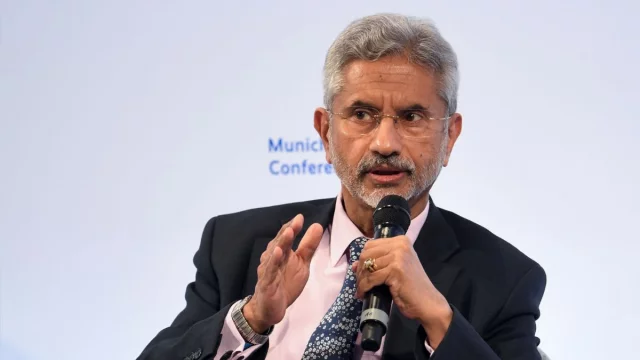
Indian External Affairs Minister S Jaishankar has said that any relationship can remain effective only if it passes the test of “mutual interests”, a remark that comes amid uncertainty over the current state of India-Bangladesh relations.
Jaishankar made the comments on Saturday while speaking at the Economic Times World Leaders Forum in New Delhi, where he discussed India’s relations with Bangladesh and other neighbouring countries, including Pakistan.
Asked about Dhaka’s demand for the extradition of former Bangladesh Prime Minister Sheikh Hasina, Jaishankar declined to comment directly on the issue.
“I can tell you that for any relationship to be effective, it has to pass the test of mutual interests. It has to be beneficial to us as well,” he said.
Elaborating on India’s approach towards its neighbours, Jaishankar said New Delhi did not expect neighbouring countries to work solely in India’s interests.
“I don’t expect my neighbours to work only to protect my interests. Just as I expect them to understand and respect my interests, I have to have a reasonable balance on my part in understanding and respecting their interests,” he said.
The Indian foreign minister said bilateral relationships move forward when there is a basis for accommodation and consensus.
At the heart of any deep bilateral relationship, he said, are mutual interests.
His remarks come at a sensitive time for Bangladesh-India relations, with the two countries seeking to navigate several contentious issues, including the presence of former Prime Minister Sheikh Hasina in India and Dhaka’s request for her return.
Hasina left Bangladesh and went to India following the fall of her government amid a mass uprising. The interim and subsequently elected government in Dhaka has repeatedly sought her return, while New Delhi has said it is examining the request.
Jaishankar’s comments also come amid uncertainty over a possible visit to India by Bangladesh Prime Minister Tarique Rahman. Informal discussions between Dhaka and New Delhi have reportedly continued over the possible visit, although no final decision has been announced.
Bangladesh’s foreign policy under the new government has emphasised national interests and balanced relations with major powers and neighbouring countries.
For New Delhi, meanwhile, maintaining stable relations with Dhaka remains strategically important because of Bangladesh’s geographic position, connectivity with India’s northeastern states, trade links and wider security interests in the Bay of Bengal region.
Jaishankar’s emphasis on mutual interests suggests that India expects bilateral relations to be shaped by reciprocity rather than by one-sided expectations.
The two countries have historically maintained extensive cooperation in trade, connectivity, energy, border management and security. At the same time, differences over issues such as water sharing, border incidents, trade barriers and political developments have periodically strained ties.
Against this backdrop, Jaishankar’s remarks are likely to be closely watched in Dhaka as both sides consider the next phase of their bilateral engagement.