Play store

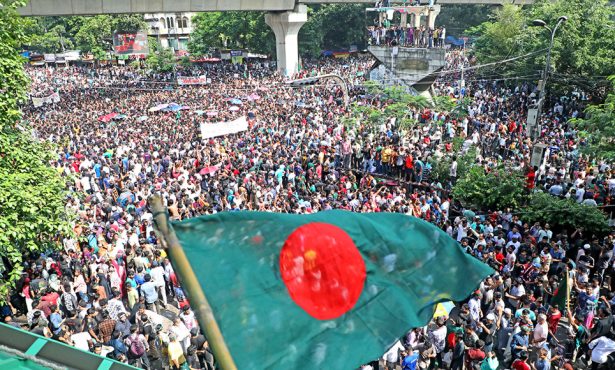
Being invigorated with support from a good number of political groups and professional bodies along with active participation in the movement by students from all public universities across the country on the previous day, the Anti-quota movement organizers finally came up with the more stringent ‘Bangla Blockade’ programme on 6 July 2024.
In the July uprising, the ‘Bangla Blockade’ idea aimed at forcing the government of deposed Prime Minister Sheikh Hasina to give in to the demands of the university students and job seekers through a complete shutdown of the country had added a fresh momentum to the agitation.
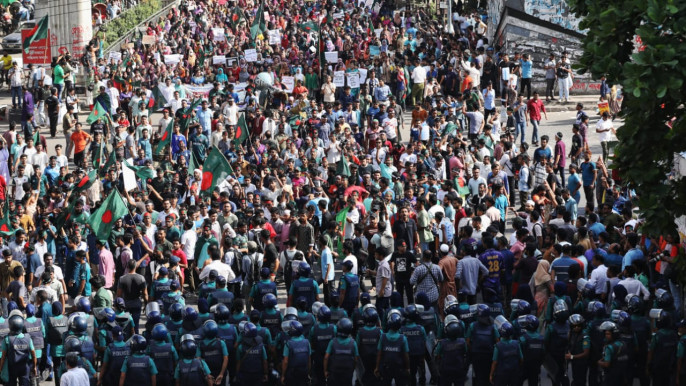
On the sixth consecutive day, enthusiastic protesters in their droves thronged the heart of the capital, Shahbagh intersection, the symbolic ground zero of student uprisings, blocking once again the vital traffic point. By mid-afternoon, several thousand students poured into the streets, weaving through Dhaka University, BUET, and Eden College campuses before converging on Shahbagh. They raised slogans: “Dofa ek, dabi ek: quota not come back!”, “Quota na medha — medha, medha!”
Nahid Islam, a Dhaka University student and key organiser, announced that the “Bangla Blockade” will now take place daily from 3:00pm at key intersections in the capital as well as highways across the country.
“We will not return to classrooms until our demands are met,” he declared to a cheering crowd, urging parents to join the movement and accusing the ruling party’s student activists of attempting to disrupt the protests. As the hours stretched on, police presence loomed nearby, while the demonstrators remained non-violent.
Elsewhere in Dhaka, Jagannath University students blocked the Tanti Bazar intersection, joined by students from Kabi Nazrul Government College and Shaheed Suhrawardy College. Their march paraded through the streets before settling into an hours-long blockade that brought traffic to a halt.
The students’ demands remained unchanged: abolish the reinstated quotas in government jobs; form a commission to revise the quota system, ensuring fairness and meritocracy; and introduce limits on the number of times an individual may use quota privileges. Their frustration was intensified by the Appellate Division’s decision to uphold the High Court verdict reinstating the quotas.
Outside Dhaka, protesters occupied the streets with equal resolve.
In the port city, students of Chittagong University staged roadblocks for a second consecutive day, gathering at the bustling Muradpur-GEC intersection.
In Rajshahi, university students brought the Dhaka-Rajshahi highway to a halt for an hour.
In Rangpur, students of Begum Rokeya University paralysed the Dhaka-Rangpur highway, while in Tangail, students of Maulana Bhashani Science and Technology University blocked the main highway for 90 minutes. Even torrential rain could not dampen the spirit of protest — as seen in Kushtia, where students of Islamic University, drenched but determined, brought traffic to a standstill outside their campus.
In Khulna, students from various institutions, including Khulna University, gathered at Shibbari intersection. In Mymensingh, students from Ananda Mohan College rallied at the Town Hall intersection. Each blockade, whether lasting 30 minutes or several hours, sent the same message: the youth will not be silenced.
The movement, though leaderless in structure, grew more organised by the day. Messages circulated online, banners appeared overnight, and campuses became hubs of mobilisation.
At last a vital support for the movement came from the main opposition party BNP. BNP Secretary General Mirza Fakhrul Islam Alamgir expressed moral support for the students, though the protesters themselves remained wary of partisan influence, insisting their movement was rooted in justice, not party politics.
As the sun set on July 6, one reality became clear: the movement is gaining unstoppable momentum. The call for a “Bangla Blockade”, announced for the following day, signaled the protesters’ determination to escalate their struggle into a nationwide civil resistance.