Play store

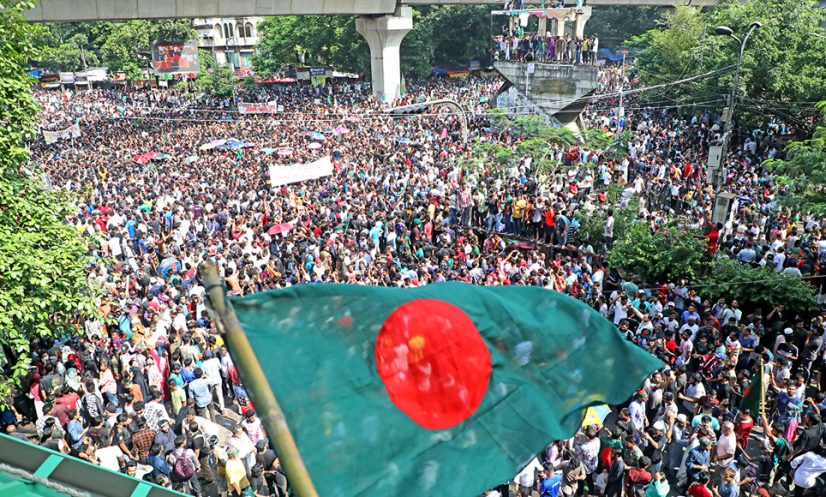
In the run-up to the climax of the historic mass upsurge toppling the fascist Sheikh Hasina’s regime, the memorable 2 July 2024 had turned out be a significant turning point in the month-long street movement. Braving heavy rain, threats from security forces and ruling party activists, and fatigue, the anti-quota protests gained momentum for the second consecutive day as hundreds of students and job seekers occupied the streets of Dhaka.
Being imbued with the previous day’s successful mobilisation, the protesters moved on with their demand to reinstate the 2018 circular that had abolished quotas in government jobs — a circular recently nullified by a High Court verdict.
The activists of Boishomybirodhi Chhatra Andolon (Students Against Discrimination), spearheading the vigorous agitation, came down on the streets as part of their three-day nationwide programme declared a day earlier
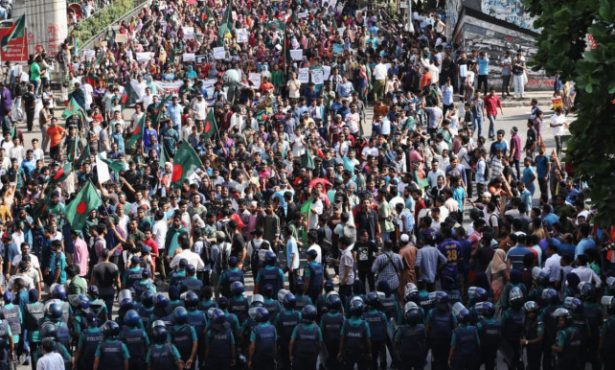
The protest started around 2:45 pm with a huge rally from the Dhaka University Library premises. The procession moved through Nilkhet, Science Laboratory, and Bata Signal, finally arriving at Shahbagh intersection.
There, the agitating students blocked the streets, obstructed traffic and chanted slogans such as “Quota na medha, medha medha” (Merit, not quota) and “Boishomyer biruddhe, direct action” (Direct action against discrimination). As they reached Shahbagh intersection, a heavy police presence had already taken position. Addressing the law enforcers, the students shouted “Bhua bhua” (fake, fake). But no clash occurred at this and the police eventually stepped aside.
By that time, the student movement had changed its nature, objective and dimension. It was absolutely due to the situation on the ground and growing people’s support for the student movement. While addressing the students gathering at Shahbagh, Nahid Islam, coordinator of the movement, said
“This movement is not just about students or job seekers — it’s about the kind of state we want to build,”
“The spirit of the Liberation War is not a hereditary privilege; it is a national ideal. We, the youth, are upholding that spirit by standing against discrimination.”
Nahid Islam declared the protests would continue the next day with a sit-in at 2:30 pm in front of the Dhaka University library and urged students across all universities and colleges in the country to join the movement simultaneously under a united banner.
The protesters held their ground at Shahbagh before lifting the blockade around 4:45 pm. From there, they marched towards the vice chancellor’s residence of Dhaka University, where they demanded the reopening of the university library, which had remained shut for two days.
Simultaneously, teachers, officials, and employees of public universities had been abstaining from work since July 1 in protest against the government’s Universal Pension Scheme, prolonging the stalemate in the activities of higher educational institutions across the country.
As Dhaka University became the epicentre of the day’s protests, similar demonstrations unfolded across other campuses as well. At Jahangirnagar University, a group of students blocked the Dhaka-Aricha highway around 3:00pm, demanding the cancellation of the reinstated quota system along with three other demands. The blockade lasted for about 20 minutes and resulted in a two-kilometre traffic snarl in both directions. Earlier, the students had held a protest rally from the base of the Shangshaptak sculpture near the university’s central library.
The protesters had also announced plans to enforce a two-hour highway blockade again on July 3, from 3:00pm to 5:00pm—further intensifying the spread of the movement beyond the capital.
Students from educational institutions across the country, including Barishal University, Jagannath University, Chittagong University, and Islamic University in Kushtia, also organised processions and rallies, occupying campus roads and entry points.
Earlier in the day, around 10:30 am, members of the pro-government organisation Bangladesh Muktijoddha Sontan Sangsad gathered in front of the Raju Sculpture at Dhaka University, opposing the anti-quota protests and advocating for the preservation of the 30 percent quota for children of freedom fighters.
By its second day, the anti-quota protest showed no signs of relinquishing amid threats from different government agencies and attacks by the ruling party goons. With swelling participation, coordinated action, and a powerful moral claim, the movement was rapidly transforming into a nationwide youth uprising — challenging not just a single policy but the deeply rooted structures of privilege and inequality.