Play store

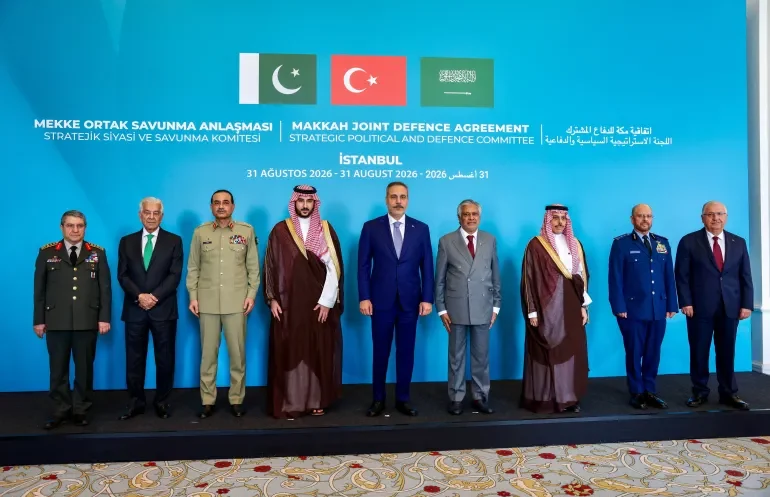
Pakistan, Saudi Arabia and Turkiye have formally named their new mutual defence pact the Mecca Defence Alliance, while signalling that the framework could eventually expand to include other countries.
The name was announced in Istanbul on Monday following a meeting of senior officials from the three founding members. Turkish Foreign Minister Hakan Fidan said the alliance would remain open to countries in the region that wish to join.
“There is a secretariat that has been established in Riyadh, and the first secretary-general will be appointed amongst our Pakistani brothers,” Fidan told a news conference after the meeting.
He said the alliance was based on international principles, including respect for national sovereignty, territorial integrity and non-interference in internal affairs.
The pact was signed by Pakistan, Saudi Arabia and Turkiye in Mecca on August 7. It states that an attack on any one of the three countries would be treated as an attack on all three.
A Strategic Political and Defence Committee established under the agreement has now begun work on translating the declaration into an operational framework. However, details of the alliance’s institutional structure and the circumstances under which its mutual-defence provision would be activated remain unclear.
Pakistan’s Foreign Ministry has said the agreement is open to other countries. Deputy Prime Minister and Foreign Minister Ishaq Dar said on August 9 that the pact was defensive in nature and would not replace existing bilateral or multilateral security arrangements.
Bangladesh signals interest
Bangladesh has emerged as one of the countries most openly interested in joining the alliance. State Minister for Foreign Affairs Humayun Kabir said Dhaka had expressed interest, adding that it would not be unusual for an Islamic country to join such an arrangement.
Egypt is also being closely watched as a potential member. Cairo participated in earlier four-way talks involving Egypt, Saudi Arabia, Turkiye and Pakistan aimed at promoting regional stability, but it did not take part in the August 7 signing.
Turkish President Recep Tayyip Erdogan said in an August 15 interview that Egypt’s accession was possible. Egyptian Foreign Minister Badr Abdelatty has said Cairo is examining constitutional and legal issues before making a decision, including the implications for its existing regional commitments.
Within the Gulf Cooperation Council, former Qatari Prime Minister Hamad bin Jassim Al Thani has publicly urged all six member states to join the alliance.
Analysts differ over which countries are most likely to join next. Some see Egypt as the most strategically important potential member because of its influence in Arab diplomacy and improving ties with Turkiye.
Others believe Gulf states such as Qatar, Kuwait and Bahrain could be more likely near-term candidates because of their close relations with the three founding members and their interest in diversifying security partnerships beyond the United States.
Analysts also caution that expansion would require the three founding countries to agree to extend their mutual security commitments to new members.
“There can be a possibility of either Egypt, Syria or Bangladesh joining,” analyst Karim said, “but it will take some time to develop the required understandings amongst all stakeholders.”