Play store


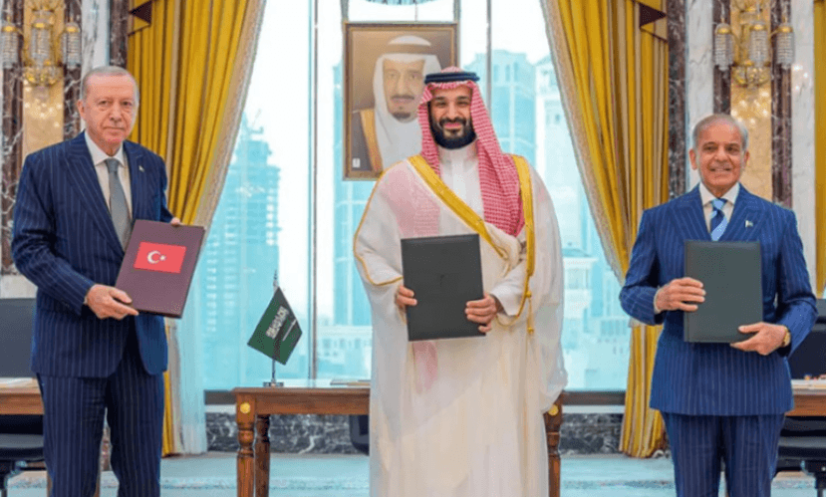
The reported emergence of the Makkah Defence Alliance among Türkiye, Saudi Arabia and Pakistan has opened a new and potentially consequential chapter in the geopolitics of the Muslim world. For Bangladesh, the question is no longer simply whether it should welcome a new security arrangement among Muslim-majority countries, but whether joining such an alliance would serve its long-term national interests.
The 31 August 2026 meeting in Istanbul reportedly agreed to operationalise the trilateral security framework, with Riyadh designated as the headquarters and secretariat and Pakistan expected to provide the alliance’s first secretary-general. A Strategic Political and Defence Committee, comprising foreign, defence and military leadership, is also expected to oversee areas such as joint military planning, intelligence cooperation and defence-industry collaboration.
Yet the meeting has also raised an important question: What exactly is the strategic purpose of this alliance?
Supporters may portray it as an emerging collective-security mechanism for Muslim countries. Critics, however, see it as a product of the rapidly changing security environment in West Asia, particularly the confrontation involving the United States, Israel and Iran. The absence of a clear reference to de-escalation or mediation in the current US-Iran confrontation has inevitably fueled speculation about whether the alliance could eventually evolve into a broader anti-Iran security arrangement. That possibility should concern Bangladesh.
Bangladesh has traditionally pursued a foreign policy based on strategic autonomy, balanced relations and the avoidance of unnecessary military entanglements. Its geographical position is fundamentally different from that of Saudi Arabia, Türkiye or Pakistan. Bangladesh is thousands of kilometres away from the Gulf and is surrounded almost entirely by India, apart from its southeastern border with Myanmar. Its immediate security priorities therefore lie in South Asia, the Bay of Bengal, maritime security, economic development, climate vulnerability and relations with its major neighbours—not in becoming a participant in rivalries in West Asia.
The potential benefits
There are, nevertheless, compelling reasons for Dhaka to examine the alliance seriously.
First, membership could provide Bangladesh with greater access to defence cooperation, military training, intelligence-sharing and defence technology. Bangladesh’s armed forces have increasingly sought modernisation and diversification of defence partnerships. Cooperation with Türkiye and Pakistan, in particular, could potentially create opportunities in defence production, military education and technological exchange.
Second, an alliance involving major Muslim countries could strengthen Bangladesh’s diplomatic influence within the broader Muslim world. Dhaka has historically maintained close relations with Saudi Arabia and other Gulf states, while its relationship with Türkiye has expanded considerably in recent years. A structured multilateral platform could provide Bangladesh with another channel through which to advance its economic and diplomatic interests.
Third, closer institutional ties with Saudi Arabia could potentially generate economic dividends. Saudi Arabia is an important source of employment for Bangladeshi workers and a significant economic partner. Greater political and security engagement might help Dhaka pursue investment, energy cooperation, infrastructure projects and labour-market opportunities.
There could also be benefits in areas such as counterterrorism, cyber security, maritime security and disaster response—provided cooperation remains defensive and consistent with Bangladesh’s existing foreign-policy commitments.
But the risks may be greater
The principal danger is that Bangladesh could become involved in a geopolitical confrontation that has little direct connection to its national security.
If the Makkah Defence Alliance develops into a mechanism primarily designed to counter Iran, membership could force Bangladesh into an uncomfortable strategic position. Dhaka maintains diplomatic relations with Tehran and has no obvious national interest in becoming a party to the Saudi-Iranian strategic rivalry.
An alliance obligation can also create expectations during a military crisis. If collective defence provisions eventually require members to support one another militarily, Bangladesh could face pressure to provide troops, logistical assistance, intelligence or political support in conflicts far from its borders.
That would represent a significant departure from Bangladesh’s traditional preference for peacekeeping rather than power projection.
There is another consideration: Bangladesh’s relationship with India. Although New Delhi has its own complex relationships with Saudi Arabia, Türkiye, Pakistan and Iran, Dhaka must carefully calculate how its participation in a new military bloc would be interpreted by its largest neighbour. Bangladesh cannot afford to allow its foreign-policy choices to unnecessarily complicate relations with India, particularly when trade, water-sharing, border management, connectivity and regional security remain critical national interests.
Perhaps the most important question is whether the proposed alliance is genuinely a collective-security arrangement for the Muslim world or primarily a mechanism for protecting the strategic interests of its founding members.
Saudi Arabia has legitimate reasons to seek stronger security guarantees. Recent developments in the Gulf have demonstrated the limitations of relying exclusively on external security providers. Türkiye, meanwhile, has ambitions for greater strategic autonomy, while Pakistan possesses considerable military capabilities and longstanding security experience.
Their interests can overlap, but they are not necessarily identical to those of Bangladesh or other prospective members.
Calling the arrangement “Muslim NATO” may therefore be politically attractive, but the comparison should be treated cautiously. NATO emerged from a clearly defined European security environment and has a formal collective-defence structure. A Muslim-majority security organisation would have to reconcile very different national interests, threat perceptions and foreign-policy priorities.
The fact that Muslim-majority countries have so far shown limited enthusiasm for immediately joining should also encourage Dhaka to proceed cautiously. Bangladesh does not need to be among the first countries to enter an alliance whose institutional structure and strategic objectives are still evolving.
Bangladesh should wait, watch and negotiate
For Bangladesh, the best policy may therefore be strategic patience rather than immediate commitment.
Dhaka should first seek clarity on several fundamental questions: What constitutes an attack on a member? Is military assistance mandatory? Is the alliance directed against any particular state? Will members be expected to support military operations outside their territories? How will disputes among members be handled? And, crucially, will the organisation remain defensive and compatible with the principles of the United Nations Charter?
Bangladesh should also insist that any future membership must preserve its freedom to maintain independent relations with countries outside the alliance.
There is nothing inherently wrong with Bangladesh strengthening defence cooperation with Muslim-majority countries. Nor should Dhaka ignore the economic and technological opportunities that a new regional security platform might offer. But security partnerships should serve national interests, not become instruments of geopolitical rivalry.
Bangladesh’s strategic value lies partly in its ability to maintain constructive relations with competing powers and blocs. It should therefore avoid exchanging that diplomatic flexibility for uncertain security guarantees.
The Makkah Defence Alliance could eventually become a useful platform for cooperation among Muslim countries—or it could become another arena for great-power and regional rivalry. At this stage, nobody can be certain.
For Bangladesh, the wisest course is neither to embrace nor reject the alliance prematurely. It should engage diplomatically, study its evolving structure, negotiate safeguards and assess the costs and benefits from a strictly national-interest perspective.
In an increasingly polarised world, Bangladesh needs more strategic options, not fewer. Joining a military coalition may provide new opportunities, but preserving the freedom to say “no” when national interests demand it may prove to be an even greater strategic asset.