Play store

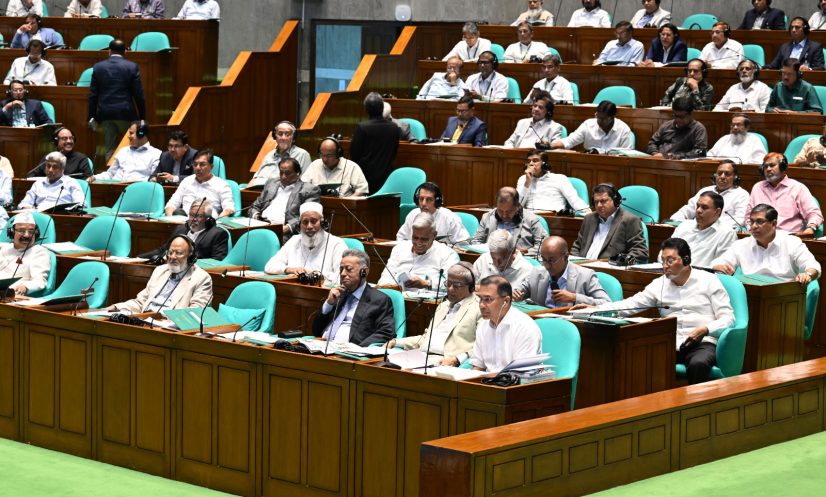
The Jatiya Sangsad (JS) on Monday passed the Finance Bill, 2026 with a series of significant amendments, including raising the income tax-free threshold for individual taxpayers, withdrawing a controversial investment disclosure provision and reducing taxes and duties on several sectors to spur economic activity.
Finance Minister Amir Khasru Mahmud Chowdhury moved the bill, which was passed by voice vote with Speaker Hafiz Uddin Ahmad, Bir Bikram, presiding.
The revisions came in response to proposals made by the Prime Minister during the budget discussion, prompting the government to revise several key measures in the national budget for the 2026-27 fiscal year.
Under the revised Finance Bill, the income tax-free threshold for individual taxpayers has been increased to Tk 400,000 for FY2026-27 and FY2027-28. The ceiling will rise to Tk 450,000 for FY2028-29 and FY2029-30 and reach Tk 500,000 in FY2030-31.
The proposed budget had initially set the tax-free threshold at Tk 375,000 for FY2026-27, Tk 400,000 for the following two fiscal years and Tk 450,000 thereafter.
The finance minister also withdrew the proposed provision requiring disclosure of certain investments after it drew public criticism and created confusion.
He said the measure had been intended to protect taxpayers from complications arising because many land transactions are registered at mouza values rather than actual market prices. However, respecting public opinion, the government decided not to proceed with the proposal.
Two other proposed measures were also withdrawn. These included making Taxpayer Identification Number (TIN) certificates mandatory for opening most bank accounts and requiring TIN certificates for registering partition deeds and property mutations.
The Finance Bill reduces the income tax rate for private universities from 10 percent to 5 percent.
It also expands tax exemptions for indigenous communities in both the Chattogram Hill Tracts and the plains by exempting salary income, in addition to earnings from business, agriculture and other economic activities.
To strengthen the shrimp industry, the government proposed exempting imported shrimp feed, probiotics, vitamins, minerals, essential inputs and related machinery from customs duty, regulatory duty, supplementary duty and VAT.
The Finance Bill also includes duty concessions on imported industrial raw materials and withdraws the existing 10 percent supplementary duty on imported honey used by pharmaceutical and other manufacturing industries.
Import duty on PVC and PET resin, key industrial raw materials, has been reduced from the proposed 10 percent to 5 percent.
The government also withdrew proposed regulatory duties on imported cold-rolled steel sheets used for fire doors, coated chromium oxide for flat steel products and refined copper wire used in electrical cable manufacturing.
In addition, the proposed 15 percent VAT and advance tax on imported fire bricks have been scrapped.
Customs duty on imported unprocessed cashew nuts, used by the domestic processing industry, has been cut from 15 percent to 5 percent.
Duty concessions on imported raw materials for locally manufactured LED lights and prefabricated buildings have also been extended until June 30, 2030.
To encourage the use of formal payment channels for digital advertising, the government reduced VAT on advertisements placed through social media platforms, OTT services, search engines, online marketplaces and other digital platforms from 15 percent to 5 percent.
The minister said the lower VAT rate is expected to discourage informal overseas payments while improving tax compliance.
The Finance Bill also fixes VAT on gold, platinum and diamond jewellery at Tk 2,500 and on silver jewellery at Tk 100.
It exempts the 15 percent VAT on revenue-sharing arrangements with the Bangladesh Telecommunication Regulatory Commission (BTRC) and grants full VAT exemption at the supplier level for all fish supplies.
To promote domestic automobile production, VAT on locally manufactured double-cabin pickup trucks and microbuses has been reduced from 15 percent to 5 percent.
The government has also relaxed coefficient filing requirements under the VAT system for selected sectors in a move aimed at simplifying tax compliance for businesses.
The Finance Bill incorporates the government’s revised fiscal measures ahead of the approval of the national budget for the 2026-27 fiscal year, reflecting changes made following consultations with lawmakers, businesses and other stakeholders.