


 Play store

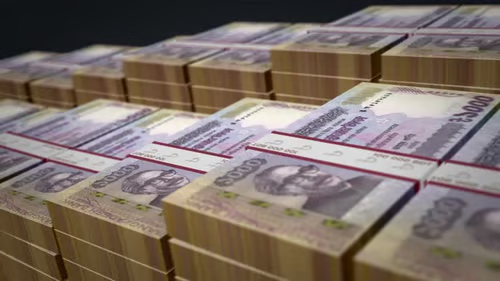
The government’s domestic borrowing rose sharply in the first nine months (July–March) of fiscal year 2025-26, driven mainly by increased borrowing from the banking sector.
During the period, the government borrowed a net Tk 108,883.2 crore from both bank and non-bank sources, achieving 87.1 percent of its full-year domestic borrowing target of Tk 125,000 crore. In the same period of the previous fiscal year, net domestic borrowing stood at Tk 80,115.7 crore, or 68.5 percent of the annual target.
The latest report of the Bangladesh Bank revealed these figures.
According to the report, the government planned to borrow Tk 125,000 crore from domestic sources in the current fiscal year, including Tk 104,000 crore from the banking system and Tk 21,000 crore from non-bank sources. Of the non-bank target, Tk 12,500 crore was expected to come from National Savings Certificates (NSCs).
However, during July-March, the government borrowed a net Tk 109,485.6 crore from banks, almost double the Tk 53,671.9 crore borrowed during the same period a year earlier.
Bangladesh Bank said the increased borrowing came mainly through treasury bills, treasury bonds, overdrafts and other government securities.
In contrast, instead of raising funds from non-bank sources, the government made a net repayment of Tk 602.4 crore. In the corresponding period of the previous fiscal year, it had raised a net Tk 26,443.8 crore from non-bank sources.
The report said the government raised a net Tk 2,087.5 crore by selling treasury bills, treasury bonds and Bangladesh Government Investment Sukuk (BGIS) to non-bank investors, insurance companies, financial institutions and individual investors.
Net investment in National Savings Certificates remained negative. During the period, NSCs worth Tk 67,847.3 crore were sold, while repayments of matured certificates and principal totalled Tk 70,537.2 crore. As a result, the government made a net repayment of Tk 2,689.9 crore under the savings certificate scheme. In the same period a year earlier, the net repayment was even higher at Tk 8,691 crore.
The March data reflected a similar trend. During the month, the government borrowed Tk 40,617.2 crore from banks and repaid Tk 5,781.1 crore, resulting in net bank borrowing of Tk 34,836.1 crore. In March of the previous year, net bank borrowing stood at Tk 29,887.8 crore.
Meanwhile, the government collected Tk 6,692.7 crore from non-bank sources in March but repaid Tk 11,965.1 crore, resulting in a net repayment of Tk 5,272.4 crore. A year earlier, the government had borrowed a net Tk 940.5 crore from non-bank sources during the same month.
According to Bangladesh Bank, outstanding government borrowing from the banking sector reached Tk 655,515.2 crore at the end of March, while outstanding borrowing from non-bank sources stood at Tk 475,098.4 crore. Total outstanding domestic debt rose to Tk 1,130,613.6 crore, up from Tk 1,021,730.5 crore at the end of June 2025, representing an increase of nearly 10.7 percent in nine months.
The report also said the net outstanding balance of Islamic banks in the Bangladesh Government Islamic Investment Bond (BGIIB) fund increased by Tk 6,936.4 crore during July-March. Islamic banks’ investments rose by Tk 5,896.4 crore, while government borrowing from the fund increased by Tk 1,040 crore.
In addition, outstanding Bangladesh Government Investment Sukuk (BGIS), introduced to finance infrastructure projects, reached Tk 36,500 crore by the end of March. Six Sukuk bonds are currently in operation.
In its conclusion, Bangladesh Bank said that most of the government’s domestic borrowing during the first nine months of the fiscal year came from the banking sector. With non-bank financing, particularly National Savings Certificates, remaining in negative territory, the government’s dependence on bank borrowing has increased further.