


 Play store

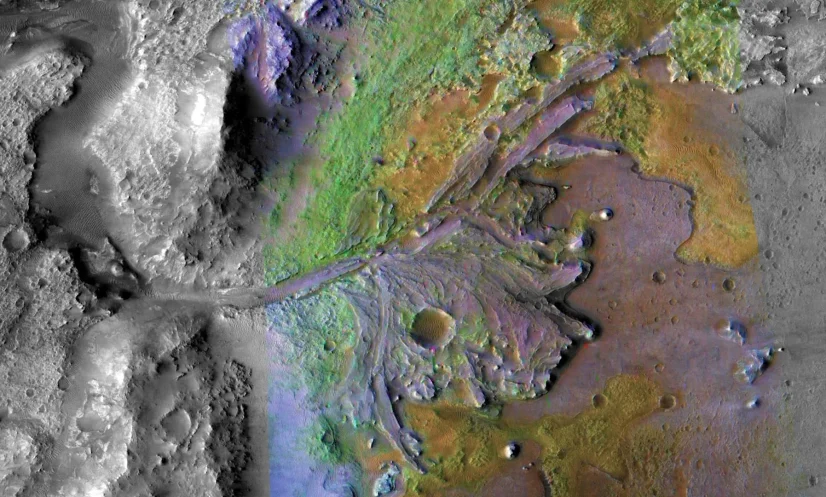
NASA’s Perseverance rover has uncovered evidence that rocks along the rim of Mars’ Jezero Crater interacted with water at least three separate times, revealing a more complex history of the planet’s ancient environment than scientists had expected.
The findings, published in Communications Earth & Environment, come from the rover’s exploration of the crater’s Margin Unit. Scientists initially expected to find sedimentary rocks deposited along the shoreline of an ancient lake, but Perseverance instead encountered igneous rocks formed from cooled magma.
Researchers say the rocks preserve a detailed record of different water-related processes that occurred long after the rocks originally formed.
Much of the evidence was gathered using Perseverance’s SuperCam instrument, which analyses the chemical and mineral composition of rocks with a laser. The rover has examined more than 185 bedrock targets across the Margin Unit.
“Now we know that this location became a sort of crossroads for aqueous systems,” said Candice Bedford, a research scientist at Purdue University and lead author of the study.
At higher elevations, Perseverance found coarse-grained, olivine-rich rocks that showed little evidence of alteration by water. Scientists believe these rocks formed deep beneath the Martian surface as magma cooled slowly, allowing large mineral crystals to develop. Erosion later exposed them at the surface.
Lower down, closer to the ancient lakebed, the olivine-rich rocks showed extensive alteration. Their mineral grains were fractured, while silica filled spaces within the rock.
The researchers identified evidence of three separate episodes of water interaction, although the timing of those events remains uncertain.
During the first episode, carbon-dioxide-rich groundwater moved through the rocks and reacted with olivine, producing carbonate within fractures. Subsequent erosion removed surrounding material and left some of the carbonate-filled fractures exposed as ridges.
A later episode of water activity may have been associated with the ancient lake that once occupied Jezero Crater. Scientists found silica in some of the rocks, particularly those located below the former waterline.
The mineral changes are of particular interest in the search for evidence of ancient microbial life. On Earth, reactions between water and olivine can produce hydrogen, which some microbes use as an energy source. The reactions can also form carbonate and silica, minerals capable of preserving evidence of past biological activity.
“Some of the Margin Unit rocks also contain silica,” said Eleni Ravanis, a planetary scientist at the University of Hawaii at Manoa and a coauthor of the study.
The researchers said the discovery is significant beyond Jezero Crater because the region is part of one of the largest exposed areas of carbonate minerals on Mars. Understanding how those carbonates formed could therefore help scientists reconstruct the planet’s ancient climate and assess whether conditions once supported life.
Perseverance continues to explore Jezero Crater and collect samples that could eventually be returned to Earth for detailed laboratory analysis.