


 Play store

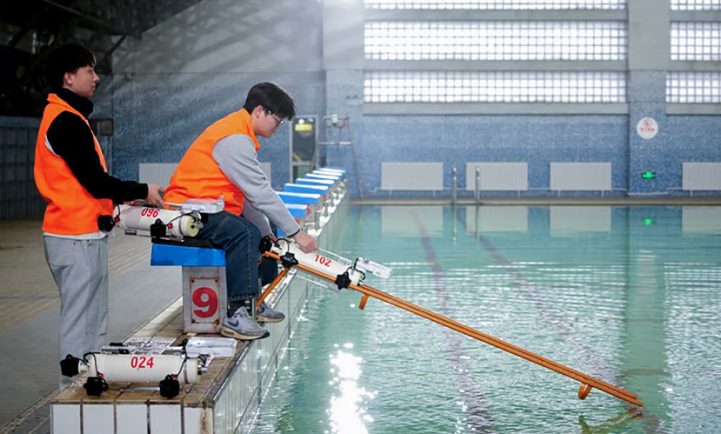
A Chinese research team has set a new world record by simultaneously operating 116 autonomous underwater drones without direct human control.
The demonstration was conducted on August 29 in a 50-metre-long and 20-metre-wide pool, with Guinness World Records officials monitoring the entire operation before recognising it as a new record.
According to Chinese media outlet Weiyuan News, the drones were developed by researchers from Northwestern Polytechnical University and Xi’an Tianhe Maritime Technologies.
Once deployed in the water, each drone relied on its onboard autonomous system for navigation and coordination. The 116 drones then travelled together for about 1,640 feet (500 metres) underwater along a designated route.
The university said in a statement that the drones used in the project were TH-618 models. Each is about 24 inches long and 7.8 inches wide, and weighs around 5 kg.
Xi’an Tianhe Maritime Technologies, a marine equipment supplier affiliated with Chinese defence contractor Xi’an Tianhe Defense Technology, collaborated on the project.
The university said enabling dozens or even hundreds of underwater vehicles to operate autonomously, continuously and in a coordinated manner remains a major challenge in the development of intelligent underwater systems.
The drones used real-time data to coordinate their movements. If a unit deviated from its designated route, its autonomous control system automatically corrected its course and returned it to the planned path, allowing the entire group to move in a coordinated swarm.
Underwater communication presents an additional challenge because radio signals do not work as reliably underwater as they do on land. Researchers said the successful coordination of such a large number of drones without human intervention represents significant progress in autonomous underwater technology.
The drones can travel up to 30 km on a single charge and operate continuously for more than eight hours, according to the university.
Cameras installed on the drones help determine their position and monitor the surrounding environment. The autonomous system can also adjust their routes when they are affected by water currents or other factors.
Researchers said the technology could eventually be used for seabed surveys, underwater infrastructure monitoring and inspections of oil and gas pipelines.
Northwestern Polytechnical University has been researching underwater sensing, acoustic communication and visual perception technologies for more than two decades.