Play store

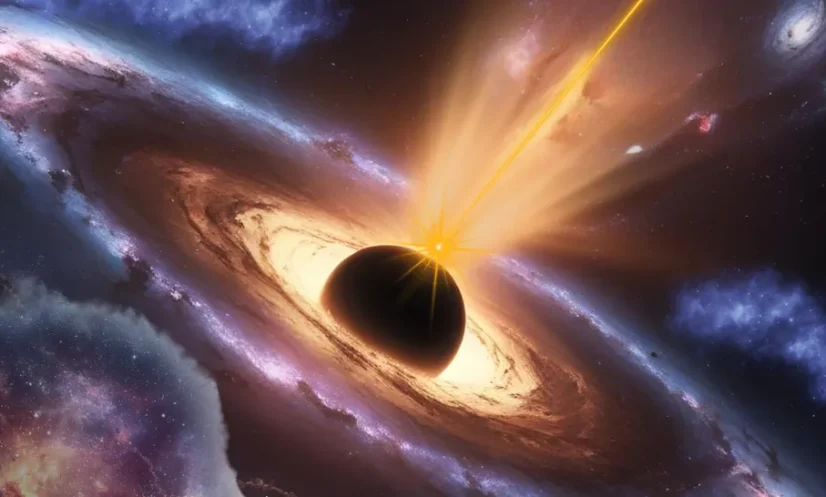
Scientists have found evidence that jets launched by supermassive black holes can disrupt gas surrounding entire galaxies, potentially shutting down star formation and determining how galaxies eventually “die”.
The finding may help solve a long-standing astronomical question: why do galaxies contain far fewer stars than expected despite being surrounded by vast reservoirs of gas and dust that can serve as raw material for new stars.
Researchers led by Sanchayeeta Borthakur of Arizona State University and Namrata Roy of the Raman Research Institute studied hundreds of galaxies hosting actively feeding supermassive black holes.
They combined observations from the Dark Energy Spectroscopic Instrument (DESI) survey with radio observations from the LOFAR Two-meter Sky Survey (LoTSS) to trace the effects of black-hole jets.
The jets, made of high-energy plasma, can travel far beyond the central regions of galaxies. The researchers detected bright regions of ionised gas along the jets, indicating that the plasma was interacting with surrounding gas.
The strongest effects were found near the outer edges of galaxies, where the jets first encounter the circumgalactic medium, and farther out at its outer boundary, where the jets release large amounts of energy.
The researchers said this interaction can heat and disturb gas, preventing it from cooling and collapsing to form new stars or from entering the galaxy.
“A black hole is incredibly small compared to a galaxy, but its impact can reach hundreds of thousands of light-years,” Roy said.
The findings provide a new way to study how supermassive black holes regulate star formation and influence the growth and evolution of their host galaxies.
The research was published in a scientific journal.