Play store

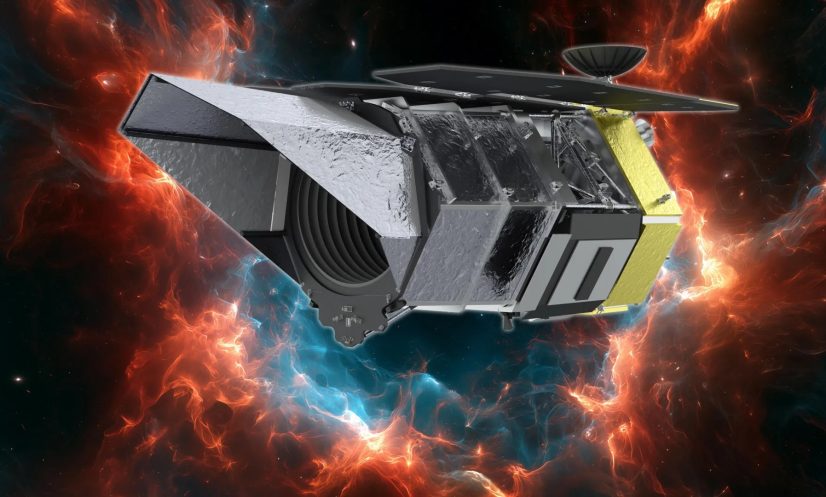
NASA’s Nancy Grace Roman Space Telescope has successfully completed a series of tests demonstrating its ability to maintain an extremely steady gaze during observations, while its Coronagraph Instrument has captured its first cosmic light.
Engineers tested Roman’s fine-guidance system from September 15 to 21 to determine whether the telescope could remain precisely locked on its targets. On September 22, the Coronagraph Instrument made its first observation of light from space.
The fine-guidance system continuously tracks precisely known guide stars and sends their positions to the spacecraft’s attitude-control system about four times a second. The system then makes tiny adjustments to counter any drift during observations.
Tests showed that Roman can maintain its pointing to better than 1/100,000th of a degree for about 30 minutes during observations with its Wide Field Instrument and for up to eight hours with the Coronagraph Instrument.
NASA said the demonstrated stability is roughly equivalent to keeping a laser focused on a US dime from about 150 miles (240 kilometres) away. Engineers expect to improve the performance further.
Unlike many other space telescopes, Roman does not have a separate guider instrument. Instead, engineers plan to test a new method that uses detailed wavelength patterns, or spectra, to guide the telescope. The spectral-guiding mode is expected to be tested in the coming weeks.
The Coronagraph Instrument is designed to block or suppress the intense light of stars, allowing scientists to study much fainter objects such as planets and dusty disks orbiting nearby stars.
The instrument made its first preliminary observations of a faint star in the Large Magellanic Cloud, a neighbouring galaxy. A subsequent observation, made after the detectors were cooled to improve sensitivity, captured multiple stars in the region.
NASA said the observations confirmed that the coronagraph can produce focused images and that Roman’s pointing system is performing as expected.
The successful tests mark another step in the commissioning of the Roman Space Telescope as engineers prepare it for more complex observations and its future scientific mission.