Play store


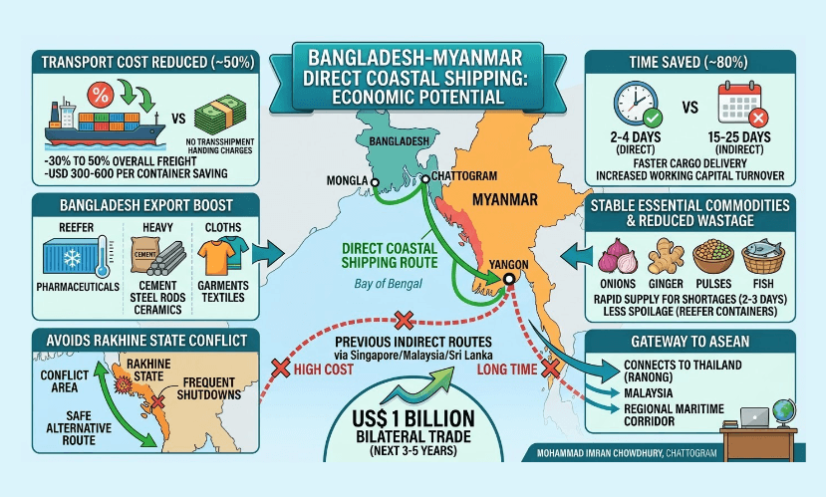
Bangladesh and Myanmar are immediate neighbors sharing a direct border. Yet, because there is no direct coastal shipping between the two countries, bilateral cargo must be routed through third-country ports like Singapore, Malaysia, or Sri Lanka. This roundabout journey causes massive delays and drastically inflates freight costs.
Launching a direct coastal shipping service between the two nations would transform bilateral trade. The primary benefits of this shift include:
1. Transport Costs Cut by Nearly Half:
Elimination of transshipment expenses:
Currently, containers must be unloaded and reloaded at intermediate foreign ports. Direct vessels would eliminate these third-party handling charges, saving between $300 and $600 per container (reducing overall freight charges by 30% to 50%).
Fuel savings:
The maritime distance from Chattogram to Myanmar’s Yangon port is only 600 to 700 nautical miles. Eliminating the long detour cuts vessel fuel consumption substantially.
2. Transit Time Reduced by Around 80pc:
Faster cargo delivery:
Indirect routes take anywhere from 15 to 25 days in transit. Direct coastal shipping from Chattogram or Mongla to Yangon would take just 2 to 4 days.
Faster capital turnover:
Because goods spend far less time stuck in transit, importers and exporters can turn over their working capital much faster—providing vital relief to small and medium-sized enterprises (SMEs).
3. A Substantial Boost for Bangladeshi Exports:
Capturing the pharmaceutical market:
Bangladeshi medicines have strong demand and a solid reputation in Myanmar. Direct shipping with refrigerated (reefer) containers ensures proper temperature control and lower freight costs, allowing Bangladeshi pharmaceuticals to compete effectively on price against Indian and Thai products.
New avenues for heavy industrial goods:
Shipping heavy products like cement, steel rebars, ceramics, PVC pipes, and melamine via road or roundabout sea routes is prohibitively expensive. Direct coastal shipping opens an affordable sea corridor for these bulk items.
Garments and fabrics:
Bangladeshi suppliers can reliably ship yarn and fabrics to Myanmar’s garment factories, as well as finished apparel for Myanmar’s retail market.
4. Market Relief for Essential Commodities and Reduced Wastage:
Rapid shortage relief:
Bangladesh routinely imports onions, ginger, garlic, pulses, and marine fish from Myanmar. When domestic shortages arise, direct vessels can deliver large consignments within 2 to 3 days to stabilize local prices.
Preventing spoilage of perishables:
Trade historically relied on overcrowded wooden trawlers making slow, exposed voyages, leading to significant spoilage. Shipping directly in temperature-controlled containers will virtually eliminate this waste.
5. Bypassing Border Conflicts and the Rakhine Crisis:
The vast majority of bilateral border trade currently runs through the Teknaf land port in Cox’s Bazar. Internal conflicts and active fighting in Myanmar’s Rakhine State often shut this land port down for months at a time, bringing trade to a halt.
Direct coastal shipping avoids unstable border areas entirely, directly connecting Chattogram and Mongla with Yangon, Myanmar’s main commercial hub. This keeps international commerce insulated from border strife.
6. A Gateway to the ASEAN Region:
Myanmar serves as a natural land bridge between South Asia and Southeast Asia. A successful direct route to Myanmar lays the groundwork for an expanded regional maritime corridor extending to Ranong Port in Thailand and onward to ports in Malaysia.
What Needs to Happen Next:
To unlock the full potential of this initiative, two priority issues must be resolved:
Clearing payment and banking bottlenecks:
Due to international financial sanctions involving Myanmar, opening and settling Letters of Credit (LCs) through standard banking channels remains difficult. Setting up a bilateral local-currency trading mechanism (settling trade directly in Bangladeshi Taka and Myanmar Kyat) is essential.
Deploying suitable vessels and digital customs:
Both countries need to ensure an adequate supply of shallow-draft, medium-sized container vessels suited for coastal waters, alongside expedited, paperless customs clearance at ports.
With direct coastal shipping in place, bilateral trade between Bangladesh and Myanmar could comfortably cross the $1 billion mark within the next 3 to 5 years.