Play store

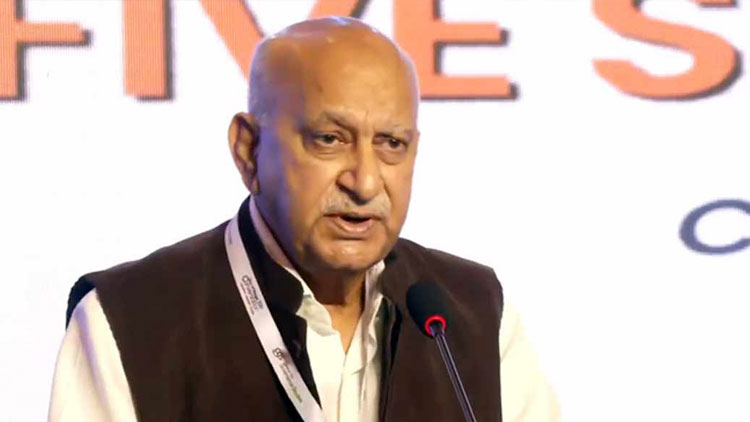
Former Indian Minister of State for External Affairs M J Akbar has said temporary strains and ups and downs in India-Bangladesh relations will not damage the long-standing bond between the two countries.
He also called for a broader approach to resolving bilateral problems, saying it was important to ask not only “what is possible” but also “why something is considered impossible”.
Akbar made the remarks while speaking at the Bay of Bengal Conference on Sunday.
He described both India and Bangladesh as civilisational states, saying Bangladesh’s identity was not that of an artificially created state but one rooted in the strength of its language and its own distinct civilisation.
Discussing bilateral relations, Akbar said ups and downs between the two countries were inevitable. However, he argued that addressing existing problems required looking beyond what could be done and questioning why certain solutions were considered impossible.
Such an approach, he said, could open up new possibilities for resolving outstanding issues.
Emphasising the importance of sovereignty, Akbar said a lack of respect for sovereignty could push the world towards greater disorder.
On wars and conflicts in the contemporary world, he said the origins and background of any conflict should be examined when describing a war as illegal.
Akbar described the 20th century as a century of three world wars and also referred to the Cold War as a form of world war. He said that although the Cold War was “cold” in Europe, its impact was far from cold in Southeast Asia and southern Africa.
He said such conflicts were described as world wars not because the entire world directly participated in them, but because they involved struggles among major powers and empires over global influence and control.
Akbar also said the nature of warfare in the 21st century was different from that of earlier periods. He argued that current conflicts could not be viewed as a single world war but rather as a series of conflicts taking place across the globe.
According to him, these conflicts may occur in phases and do not continue continuously, but neither do they come to a complete end.