


 Play store

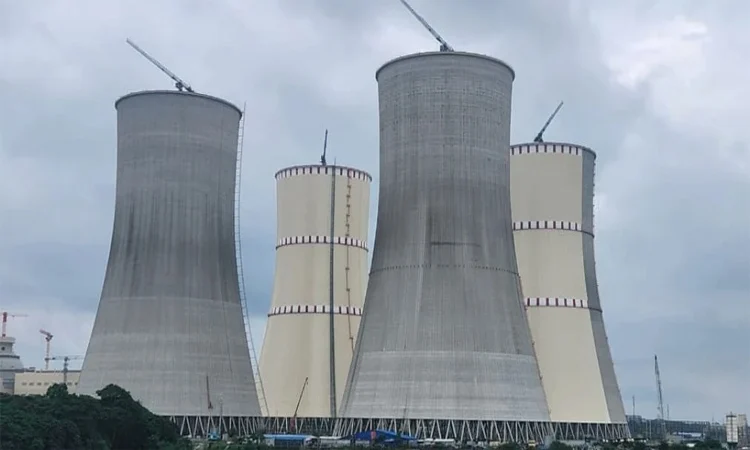
Regulatory approval of safety valve test results clears the way for the next stage of commissioning, with trial electricity supply targeted as early as next month
Bangladesh’s first nuclear power plant at Rooppur in Ishwardi, Pabna, has moved closer to starting nuclear fission in its first unit after the country’s nuclear regulator approved the results of safety valve tests, paving the way for the next phase of commissioning.
If work proceeds as planned, the plant could begin supplying electricity to the national grid on a trial basis as early as next month, project officials said.
The Rooppur Nuclear Power Plant has two units, each with a generation capacity of 1,200 megawatts (MW). Once fully operational, the two units are expected to supply a combined 2,400MW, helping diversify Bangladesh’s energy mix and reduce reliance on fossil fuels.
Officials of the Bangladesh Atomic Energy Regulatory Authority (BAERA) said the initiation of heat production through nuclear fission in the first unit had initially been planned for September. However, technical defects detected during safety valve testing delayed the process.
The test results were submitted to the regulator following two rounds of high-pressure testing and received approval last Thursday, officials said. The tests assessed whether the control valves met prescribed standards, while fire safety and radiation protection arrangements were also examined.
The approval allows the project to proceed with further reactor commissioning activities. However, officials stressed that achieving first criticality, gradually raising reactor power, starting the turbine and supplying electricity to the grid are separate stages, each requiring technical assessments and safety checks.
The next major milestone is first criticality, when a controlled, self-sustaining nuclear chain reaction begins inside the reactor. A series of tests and observations will follow, a process that could take around a month, before reactor power is gradually increased.
Initially, the plant is expected to supply around 300MW to the national grid on a trial basis. Further testing and technical assessments will be needed before commercial operation can begin.
Built with technical assistance from Russia, Rooppur uses third-generation VVER-1200 reactor technology. Project estimates suggest that the plant could meet around 10% of Bangladesh’s electricity demand when both units operate at full capacity. Its actual contribution will depend on national demand, plant performance, maintenance schedules and grid conditions.
Unlike fossil-fuel power plants, nuclear facilities generate heat by splitting uranium atoms rather than burning coal, oil or gas. The heat produces steam that drives a turbine connected to an electricity generator.
The plant is designed for an operational life of 60 years, potentially extendable by another 20 to 30 years, subject to technical upgrades, safety assessments and regulatory approval. Regular maintenance and fuel replacement will remain essential, with refuelling potentially required about every 18 months.
Sheikh Mohammad Touhidul Islam, joint secretary of the Ministry of Science and Technology’s Nuclear Power Wing, told BSS that Rooppur was not merely an electricity generation project but also an opportunity to strengthen Bangladesh’s technological capabilities and develop skilled human resources.
He said the first unit was in the final stages of preparation for power generation, while uranium for the second unit had also arrived at the project site. He expressed hope that the work could be completed ahead of schedule.
Abul Khair Md Akkas Ali, an additional secretary at the ministry, said the plant could support industrial production, attract investment and create employment opportunities.
Science and Technology Secretary Md Anwar Hossain described Rooppur as a milestone for Bangladesh’s energy security and economic development, highlighting its potential to improve electricity supplies and promote peaceful applications of nuclear technology.
Plans for the Rooppur plant date back to the years following Bangladesh’s independence, with feasibility studies and international cooperation efforts laying the groundwork for the project. The arrival of nuclear fuel at the site in October 2023 marked a major step towards commissioning.
The BNP’s 2008 election manifesto included a pledge to establish the Rooppur Nuclear Power Plant. Its 2026 manifesto also supports the continued peaceful use of nuclear energy in the power and energy sectors.
The Ministry of Science and Technology’s Nuclear Power Wing coordinates the project on behalf of the government, while Russia’s state nuclear corporation Rosatom provides technical assistance.
As the first unit approaches its initial operational milestone, Rooppur is expected to become an important part of Bangladesh’s long-term energy strategy.
The timeline for power generation, however, will depend on the successful completion of all commissioning stages and compliance with technical and regulatory safety requirements.
Source : BSS