Play store

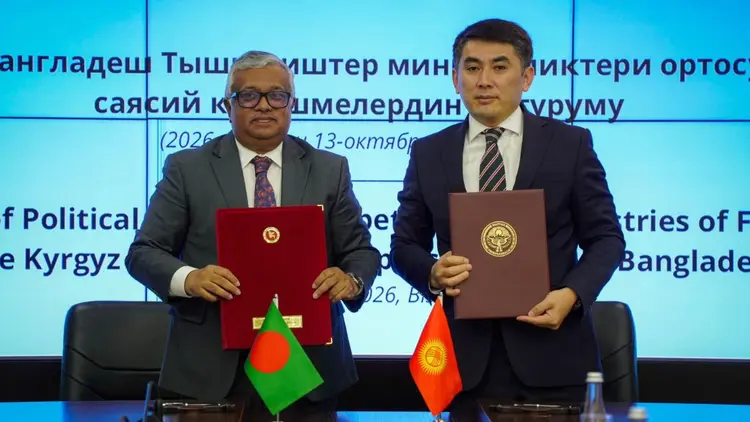
Bangladesh and Kyrgyzstan have signed two memorandums of understanding (MoUs) to strengthen bilateral ties, expand diplomatic cooperation and promote practical collaboration in areas including trade, investment, education and technology.
The agreements were signed on Tuesday, October 13, in Bishkek, the capital of Kyrgyzstan, during a Foreign Office Consultations (FOC) meeting.
One MoU focuses on cooperation between the foreign service academies of the two countries, while the other outlines an action plan for cooperation between their foreign ministries for 2026–2027.
Bangladesh Foreign Secretary Ambassador Asad Alam Siam led the Bangladeshi delegation, while Kyrgyz Deputy Foreign Minister Kairat Tursunkulov headed the Kyrgyz side. Both signed the agreements on behalf of their respective countries.
During the consultations, the two sides reviewed bilateral relations and discussed cooperation in trade and investment, education and scholarships, labour mobility, business-to-business engagement, parliamentary exchanges, high-level visits, information technology, technology transfer, culture, tourism and visa facilitation.
They also agreed to jointly celebrate the 35th anniversary of the establishment of diplomatic relations between Bangladesh and Kyrgyzstan in 2027.
Both countries underscored the importance of tapping the untapped potential of their bilateral relationship. They agreed to strengthen political engagement through high-level exchanges, including meetings between their foreign ministers.
The delegations also pledged to expand cooperation in regional and international forums, including the United Nations, the Organisation of Islamic Cooperation (OIC) and the Shanghai Cooperation Organisation (SCO).
Bangladesh Foreign Minister Khalilur Rahman is serving as president of the 81st session of the UN General Assembly, while Kyrgyzstan is seeking a non-permanent seat on the UN Security Council for the 2027–2028 term. Against this backdrop, both sides committed to closer coordination and mutual support on key international issues.
To boost economic ties, the countries agreed to encourage greater private-sector participation and exchange business delegations.
Textiles, ready-made garments, pharmaceuticals and information technology were identified as promising sectors for expanded cooperation.
Discussions also highlighted the geopolitical importance of the Eurasian region and the opportunities it offers Bangladesh to broaden its economic engagement and access wider regional markets.
The Kyrgyz side expressed optimism about strengthening partnerships through government-level engagement, business cooperation and private-sector initiatives.
The two sides stressed the importance of strengthening people-to-people contacts through education, sports, tourism, cultural exchanges and employment opportunities.
They discussed potential employment opportunities in Kyrgyzstan for skilled and semi-skilled Bangladeshi workers, with the garment, pharmaceutical and IT sectors identified as areas of potential cooperation.
The Kyrgyz delegation also highlighted opportunities for Bangladeshi students to pursue higher education in the country, particularly at medical colleges. Both sides emphasised the need for regular and lawful arrangements governing student travel and admission.
The discussions also covered several proposed bilateral agreements and initiatives, including visa exemption for diplomatic and official passport holders, cooperation between leading business organisations, agricultural and economic cooperation, cultural exchanges, tourism, investment protection and industrial collaboration.
Following the consultations, Foreign Secretary Asad Alam Siam met Kyrgyz Foreign Minister Jeenbek Kulubaev to discuss ways to deepen bilateral and multilateral engagement for mutual benefit.
Kulubaev recalled his meeting with Bangladesh Foreign Minister Khalilur Rahman in New York in September and invited him to visit Kyrgyzstan at a mutually convenient time.
During the meeting, Siam sought Kyrgyzstan’s support for Bangladesh’s candidacies for the UN Security Council for the 2031–2032 term and the UN Human Rights Council for 2028–2030. He also requested Kyrgyzstan’s cooperation in facilitating the repatriation of Rohingya refugees sheltered in Bangladesh.
Kulubaev, in turn, expressed gratitude to Bangladesh for supporting Kyrgyzstan’s bid for a non-permanent seat on the UN Security Council for the 2027–2028 term.
The agreements and discussions mark a step towards strengthening diplomatic engagement and opening new avenues for economic cooperation, educational exchanges and collaboration on shared international priorities.