


 Play store

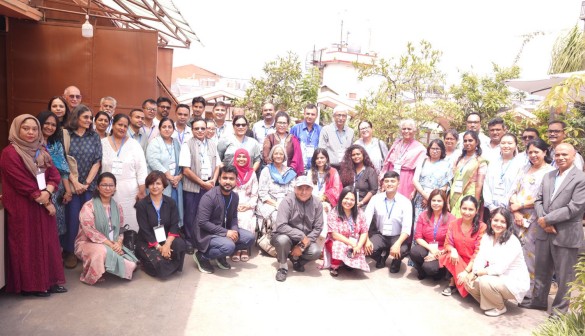
KATHMANDU, Nepal: Civil society organisations, trade union leaders, feminist advocates and youth activists from across South Asia have called for sweeping economic and democratic reforms to address mounting inequality, public debt, climate vulnerability and shrinking civic space across the region, including Bangladesh.
The call came at the South Asia Convergence 2026, organised by the South Asia Alliance for Poverty Eradication (SAAPE) in Kathmandu to mark the organisation’s 25th anniversary. The gathering brought together regional representatives to discuss people-centred alternatives to prevailing economic and political systems.
The conference highlighted how interconnected crises, including rising living costs, limited employment opportunities, climate-related disasters and growing economic insecurity, are deepening public frustration and placing pressure on democratic institutions across South Asia.
For Bangladesh, the discussions carry particular relevance as the country confronts challenges related to youth employment, inequality, climate risks and the need to ensure that economic development translates into better livelihoods and stronger social protection.
Participants argued that poverty should not be viewed simply as a lack of income but as a structural and political problem rooted in unequal access to resources, opportunities and decision-making.
They also raised concerns about the centralisation of power, digital surveillance, corporate influence over public narratives and restrictions on civic participation, warning that these trends could undermine democratic accountability across the region.
Public debt and the pressure of debt servicing emerged as major concerns during the convergence.
The conference highlighted the experiences of Sri Lanka, Pakistan, Nepal and the Maldives, where debt repayment obligations are placing pressure on public finances and limiting the resources available for essential services.
According to figures presented at the event, Sri Lanka spends more than 54 per cent of its budget on debt repayment, while Pakistan has allocated Rs 8.054 trillion for debt servicing.
Participants warned that when governments devote substantial resources to servicing debt, less funding may remain available for healthcare, education, social protection and other public services.
The discussions also called for a reassessment of economic policies that prioritise fiscal adjustment without adequately protecting vulnerable communities.
Delegates advocated fiscal reforms, including progressive taxation, stronger accountability in public spending and debt relief, arguing that the burden of economic adjustment should not fall disproportionately on low-income households.
For Bangladesh and its South Asian neighbours, the broader debate centres on how to maintain economic stability while protecting essential public investment and ensuring that development gains are shared more equitably.
Youth employment and economic insecurity formed another central theme of the conference.
Speakers noted that although young people across South Asia have growing aspirations, many struggle to find secure, adequately paid jobs. As a result, increasing numbers are turning to informal and platform-based work, often without reliable income, social security or adequate legal protection.
Workers engaged through digital platforms and companies such as Uber, Amazon and Zomato were cited as examples of a changing labour market in which flexibility can come at the expense of job security and employment rights.
In Nepal, more than 2,400 young people reportedly leave the country every day in search of better opportunities abroad, according to figures cited at the event.
Keynote speaker John Samuel described the emergence of youth-driven political mobilisation as “gig politics”, linking the phenomenon to street protests and uprisings in Bangladesh, Sri Lanka, Nepal and India.
The discussions suggested that frustration over employment, economic inequality and political exclusion can become a powerful force for mobilisation when young people see few opportunities to influence decisions affecting their lives.
Delegates stressed the need for structural economic reforms, decent employment, stronger labour protections and meaningful participation by young people in political and public decision-making.
For Bangladesh, where youth aspirations and access to quality employment remain important development concerns, the debate underlines the need to connect economic growth with secure livelihoods and opportunities for civic participation.
The convergence also examined how economic insecurity intersects with gender inequality, migration and unequal access to productive resources.
A country paper on Nepal presented at the event indicated that nearly 80 per cent of women in rural areas work in agriculture, often as men migrate in search of alternative livelihoods. Yet only 34.4 per cent of women own agricultural land.
Participants said women across South Asia continue to shoulder a disproportionate share of unpaid care work while facing wage disparities, informal employment and limited access to legal protection.
These inequalities, they argued, restrict women’s economic independence and weaken their ability to benefit fully from development.
The conference also highlighted the vulnerability of smallholder farmers and coastal communities in Bangladesh, India and the Maldives to climate-related shocks, land loss associated with large-scale projects and rising food insecurity.
In parts of coastal Bangladesh, more than 60 per cent of household income is reportedly spent on food, according to figures cited at the event, illustrating the financial pressure facing vulnerable families.
Climate change adds another layer of uncertainty for communities whose livelihoods depend on agriculture, fisheries and natural resources. Participants called for policies that protect land rights, strengthen local food systems and ensure that climate and development initiatives respond to the needs of affected communities.
They also emphasised the importance of recognising women’s contributions to agriculture and the care economy, alongside improving their access to land, finance and secure employment.
The convergence concluded with the adoption of the Kathmandu Declaration 2026, which calls on South Asian governments to move away from austerity-oriented policies and growth models that, according to the organisers, place corporate interests ahead of social welfare.
The declaration sets out several priorities for regional action.
One is universal social protection, including publicly financed healthcare, pensions and income security for informal-sector workers, domestic workers, migrants and platform-based workers.
Another is fiscal justice. The declaration calls for reforms to tax systems that rely heavily on indirect taxes such as value-added tax (VAT), which can place a disproportionate burden on lower-income households. It advocates progressive wealth taxation and debt cancellation as part of a broader effort to reduce inequality.
The declaration also stresses the protection of agricultural land rights, community food sovereignty and gender equality. It calls for safe digital and civic spaces in which people can express dissent and participate in public life without intimidation.
These demands reflect the conference’s wider argument that economic development should be assessed not only through growth and investment figures but also through improvements in living standards, access to public services, workers’ rights and democratic participation.
SAAPE Regional Coordinator Dr Netra Prasad Timsina said the convergence had provided an important platform for bringing together movements and organisations working on poverty, inequality and democratic rights.
The gathering sought to connect concerns that are often addressed separately, including public debt, precarious employment, gender discrimination, climate vulnerability and restrictions on civic space.
Participants argued that many of these challenges cross national borders and require stronger regional cooperation, shared strategies and greater participation by affected communities.
For Bangladesh, the discussions offer a regional perspective on issues ranging from youth employment and workers’ protections to climate resilience, food security and equitable public spending.
The Kathmandu Declaration sets out a common set of demands, but translating them into lasting change will depend on how governments, institutions and social movements respond to the proposals and turn regional commitments into practical policies.
The central message of the convergence was that addressing South Asia’s interconnected crises requires more than isolated measures: it calls for coordinated action on economic inequality, social protection, environmental sustainability and democratic accountability.