


 Play store

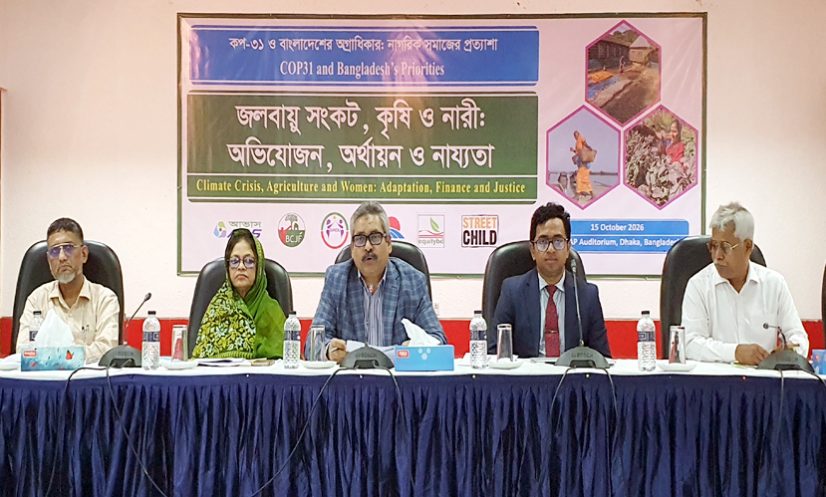
DHAKA: Climate finance for women farmers must be direct, long-term and accessible, with measurable benefits for their production, income and resilience, climate rights groups have urged ahead of COP31, calling for action on existing commitments rather than new pledges.
They also demanded grant-based climate finance without adding to developing countries’ debt burdens, the fulfilment of the commitment to triple adaptation finance, and the rapid and direct delivery of Loss and Damage funding to affected communities.
The demands were raised at a seminar titled “COP31 and Bangladesh’s Priorities: Climate Crisis, Agriculture and Women; Adaptation, Finance and Justice” at the CIRDAP Auditorium in Dhaka on Thursday. EquityBD, BCJF, COAST Foundation, AVAS, Bindu and Street Child jointly organised the event.
Speakers stressed that women farmers must be recognised not merely as a vulnerable group but as independent producers and economic actors whose participation is essential to climate adaptation and agricultural decision-making.
They called for tracking how much adaptation finance reaches women farmers and assessing its actual impact on production, income, control over resources, climate-related losses, time and labour burdens, and adaptive capacity.
The speakers also demanded equal access for women farmers to productive resources, technology, markets and decision-making, alongside integrated measures to address salinity and ensure equal pay for women agricultural workers.
M A Hasan, head of climate change at COAST Foundation, presented the keynote paper, while COAST Foundation Director Mostafa Kamal moderated the seminar.
Dr Md Akter Hossain Khan, chief seed technologist at the Seed Wing of the Ministry of Agriculture, called on grassroots organisations to unite and present their demands to the ministry. He also urged the government to establish small-scale cold storage facilities at the local level.
He said climate-resilient seeds were being developed and promoted for wider adoption.
Jasim Uddin, president of the Association of Development Agencies in Bangladesh (ADAB), said Bangladesh’s representatives in international climate negotiations needed to be more vocal and assertive.
Although Bangladesh has an agriculture-based economy, development planning had not been sufficiently centred on agriculture, he said, adding that planning had often prioritised quantitative results.
Professor Dr Mohammad Ali of Sher-e-Bangla Agricultural University questioned whether carbon trading, presented as a climate action mechanism, could legitimise the continued greenhouse gas emissions of developed countries.
Rahima Sultana Kajol, executive director of AVAS, said women farmers must have meaningful participation, leadership and decision-making power in local adaptation planning and agricultural decisions.
Imtiaz Hridoy, team lead of Street Child Bangladesh, said existing policies did not adequately recognise women farmers as a distinct group requiring targeted support.
He proposed introducing a one-stop service for women farmers at the upazila level under the Department of Agricultural Extension. The platform would enable them to access services and support from different government departments through a single point of contact.
Syed Aminul Haque, coordinator of EquityBD, called for at least 50 per cent of climate finance at COP31 to be allocated to adaptation, supported by evidence of effective spending and successful adaptation initiatives in Bangladesh.
He also stressed the need for a bottom-up approach to climate policies and strategies so that the needs of affected communities inform planning and financing decisions.
The speakers further called for financing and technology transfer to support a just transition away from fossil fuels, stressing that people intended to benefit from adaptation measures must have a meaningful role in determining priorities and assessing progress.
Women farmers attending the seminar included Nur Nahar Begum from Kuakata, Rina Begum from Satkhira, Kalpana Rani and Najma Begum. Representatives of civil society organisations, youth groups and the media also took part in the discussion.
Other participants included A K M Jasimuddin of ADAB, Md Motahar Hossain of the Environment Journalists Forum, journalist Md Salauddin Babu of SA TV, Nikhil Chandra Bhadra of the Sundarban Protection Committee, Ahsanul Wahde of Manusher Jonno Foundation, representatives of the BDCSO Process and Waterkeepers Bangladesh, and members of several environmental and youth organisations.