Play store

DHAKA: Speakers at a seminar in Dhaka have called for the Medina Charter to be included in the academic curriculum, saying its principles of equality, justice, social harmony and peaceful coexistence could help address growing divisions and disorder in society.
They said the charter had often been used as a political slogan, although many people were unfamiliar with its actual contents because it was neither taught in educational institutions nor readily available as a standalone publication.
The speakers argued that including the charter in the curriculum would help people understand its principles and prevent its misuse for political purposes.
They also said society had become increasingly divided along political and religious lines, making it difficult to maintain social order. The government, Islamic scholars and political leaders should work together to promote unity, justice and peace in the light of the charter, they added.
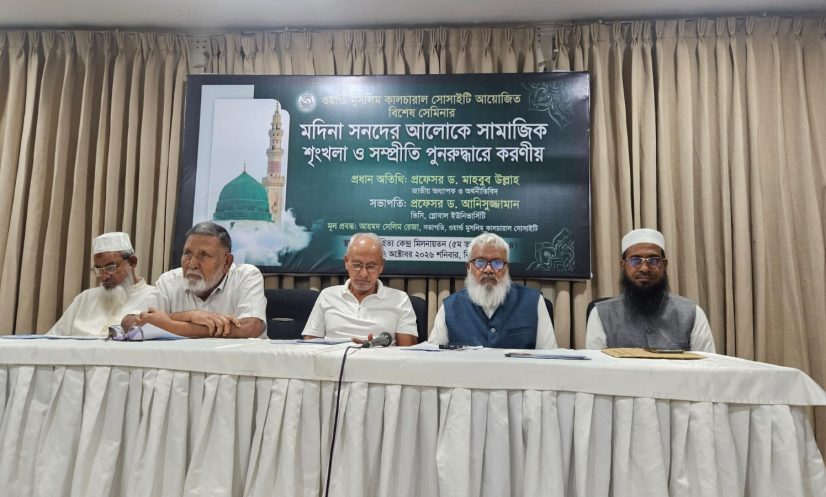
The remarks came at a seminar titled “Our Responsibilities in Maintaining Social Order and Harmony in the Light of the Medina Charter”, organised by the World Muslim Cultural Society at the Bishwa Sahitya Kendra in Dhaka on Saturday to mark Medina Day.
Professor Emeritus Dr Anisuzzaman, vice-chancellor of Global University, presided over the seminar. Ahmad Selim Reza, president of the organising body, presented the keynote paper.
Other speakers included Major General (retd) Fazle Elahi Akbar, a defence expert and chairman of the Foundation for Strategic and Development Studies; Ekushey Padak-winning rhymester and journalist Abu Saleh; Dr Muhammad Isa Shahedi, director of the Baitush Sharaf Islamic Research Centre; Associate Professor Sheikh Usman Gani of the Darul Ihsan Institute of Sufism; and Golam Mostafa Bhuiyan, secretary general of Bhashani NAP.
In his remarks, Dr Anisuzzaman said the Medina Charter, established by Prophet Muhammad (peace be upon him), had helped promote equality and justice in society.
He argued that Bangladesh’s democratic practice remained incomplete because elections and the formation of governments had not been matched by the establishment of social equality and justice.
“Democracy is not only about voting. Equality and justice are also essential components of democracy,” he said, adding that the country had long been practising a form of democracy that focused on elections without adequately ensuring fairness.
He identified compromises by the government and politicians over corruption as a major obstacle to establishing equality in the country. Referring to past remarks by political leaders about corruption, he stressed the need to address the problem to ensure justice and accountability.
Major General (retd) Fazle Elahi Akbar said restoring justice and social order was impossible without morality.
“Morality cannot be established merely through manifestos or speeches,” he said.
Referring to his experience as a former private secretary to President Ziaur Rahman, he said Zia had taken a firm stance on morality in both his personal and official life.
The speakers called for collective efforts by the state, religious scholars and political leaders to promote the principles of the Medina Charter and strengthen social cohesion.