


 Play store

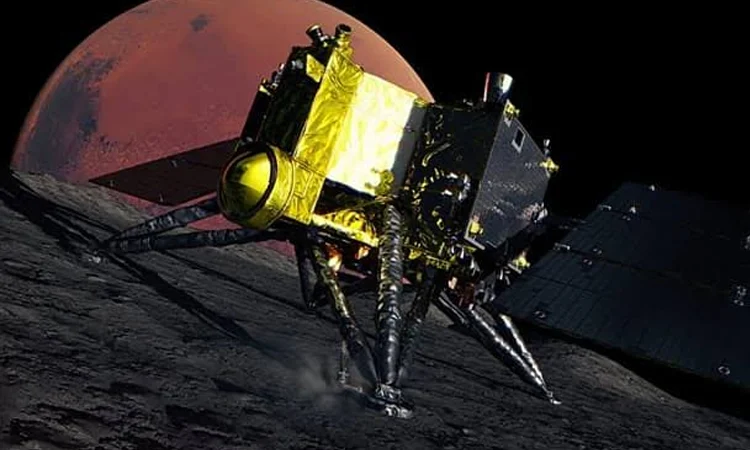
Japanese scientists are set to launch a spacecraft on Tuesday in an ambitious mission to collect samples from one of Mars’s moons for the first time, potentially shedding light on the origins of the Solar System and life on Earth.
The H3 rocket carrying the unmanned Martian Moons eXploration (MMX) probe is scheduled to lift off from the Tanegashima Space Center at 4:41 am local time (1941 GMT Monday), according to the Japan Aerospace Exploration Agency (JAXA).
If successful, the spacecraft will reach the vicinity of Mars around August next year and orbit its moon Phobos before attempting to land on the moon’s surface.
During its planned three-year mission in the Martian region, the probe aims to collect at least 10 grams of material from Phobos and return the samples to Earth. The mission is expected to mark the first round trip to the Martian region.
The project involves collaboration with US and European space agencies, universities and technology companies. It is also expected to help lay the groundwork for future human exploration of Mars.
JAXA hopes the mission will provide crucial information about the formation of Mars and its two moons, Phobos and Deimos, helping scientists better understand how the Solar System developed.
Scientists have proposed two main theories about the origin of the moons. The giant-impact hypothesis suggests that they formed from debris following a collision between Mars and another celestial body. The alternative capture hypothesis holds that they are asteroids drawn into Mars’s gravitational field.
Determining which theory is correct could help scientists understand how conditions suitable for life emerged on rocky planets, including Mercury, Venus, Earth and Mars, JAXA said.
The mission will also examine the possibility of using Phobos as a “natural space station” by identifying the requirements for round-trip journeys, a potential step towards crewed missions to Mars. The spacecraft will observe Deimos, Mars’s other moon, but will not land on it.
Meanwhile, the United States and China are pursuing their own efforts to bring samples from Mars’s surface back to Earth.
NASA’s Perseverance rover, which has been exploring Mars since 2021, has already collected rock and soil samples. However, the planned sample-return mission was effectively cancelled by US President Donald Trump’s administration following a congressional vote in January.
China plans to launch its Tianwen-3 mission around 2028, with the aim of returning Martian samples to Earth as early as 2031. Depending on the schedules of the missions, China could bring back samples from Mars before Japan’s MMX spacecraft returns with material from Phobos.