


 Play store

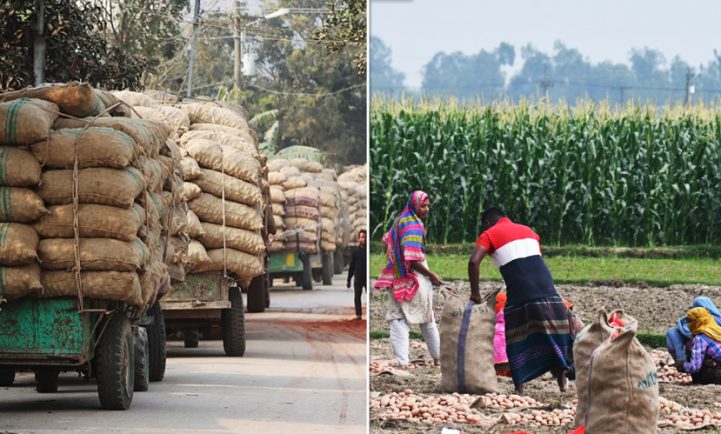
Potato farmers in Bangladesh’s northern region are facing mounting financial losses as bumper production and falling market prices leave most of their stored produce unsold, while preparations for the next planting season are already under way.
With nearly three-fourths of the potatoes stored in cold storages still unsold, farmers are grappling with deep uncertainty. At current prices, potential losses on potatoes produced in Rangpur division alone could exceed Tk 5,000 crore, with growers losing Tk 10-11 per kg.
According to the agriculture department, Rangpur division produced 5.17 million tonnes of potatoes on 197,616 hectares this year.
Of the total output, only 1.19 million tonnes, or 23.1 per cent, were stored in 124 cold storages. Some 73.8 per cent of the stored potatoes, equivalent to 882,288 tonnes, remain unsold.
Potatoes are now selling at cold storage gates for just Tk 11-14 per kg, against production costs of Tk 17-18 per kg. This translates into a loss of around Tk 800 on a 61-kg sack, excluding additional storage and handling expenses.
Farmer Mizanur Rahman of Raipur union in Pirganj upazila of Rangpur said he cultivated potatoes on 49 bighas of land this year.
He stored 5,200 sacks, each weighing 61 kg, in cold storage and sold 3,142 sacks for Tk 14.68 lakh.
However, he is uncertain how much he will recover from the remaining potatoes after paying storage rent and other expenses.
Including the cost of retrieving potatoes from cold storage, his expenses have increased significantly, leaving him facing losses of Tk 15-16 per kg at current prices.
Many farmers, including Ataur Rahman, have stopped retrieving their potatoes from cold storage because selling them at prevailing rates would deepen their losses.
Jasim Uddin, a farmer from Nagarmirganj in Rangpur city, has 500 sacks stored in two cold storages.
He said selling at current prices would result in losses of Tk 15.50-16 per kg.
Seven loss-making years in 12
Potatoes, once considered a reliable cash crop for Rangpur farmers, have increasingly become a source of financial distress.
Data from the Department of Agricultural Extension and the Department of Agricultural Marketing show that farmers incurred losses in seven of the 12 years between 2014 and 2025.
Last year, farmers reportedly left around 400,000 sacks of potatoes in cold storages because selling them was unprofitable, suffering losses of about Tk 60 crore.
Oversupply, storage constraints blamed
Industry insiders identify three major reasons behind the crisis: excessive production, inadequate storage capacity and high cold storage charges.
Bangladesh’s annual potato demand is around 8.9 million tonnes, while production in the last season reached 11.2 million tonnes, creating a surplus of approximately 2.2 million tonnes.
In Rangpur division, cold storage facilities can accommodate only about 23 per cent of total potato production, forcing farmers to sell much of their harvest during periods of weak demand.
Farmers have also complained that cold storage operators charge Tk 6-7 per kg, significantly higher than the rate recommended by a committee under the agriculture ministry.
Calls for government intervention
The government had announced a minimum potato price of Tk 22 per kg at cold storage gates and plans to procure 50,000 tonnes of potatoes.
Farmers, however, allege that the announcements have not been implemented effectively and that they have not received the promised incentives.
Mustafa Azad Chowdhury Babu, president of the Bangladesh Cold Storage Association, told Sarabangla that the government should provide subsidies to farmers and purchase potatoes if necessary.
Agricultural economist Rayan Ahmed Raju suggested subsidising 50 per cent of cold storage charges or providing direct price support to help farmers avoid losses.
Experts say long-term solutions require diversifying potato use, expanding exports and establishing potato-based industries, rather than relying solely on subsidies or emergency procurement.
Officials of the Department of Agricultural Extension have also urged farmers to plan cultivation more carefully and diversify crops, including maize, vegetables and rice, to reduce their dependence on potatoes and minimise risks from price volatility.