


 Play store

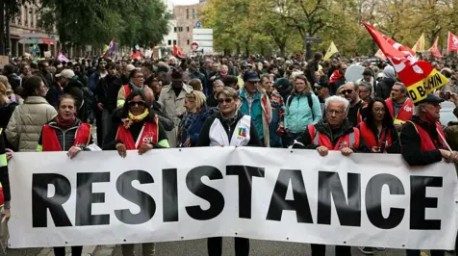
PARIS: French police have arrested 135 people as tens of thousands of demonstrators took to the streets across the country on Saturday, amid heightened security and restrictions on public gatherings following last weekend’s violent riots and widespread looting.
Interior Minister Laurent Nuñez said authorities had recorded 136 rallies by Saturday morning, involving around 35,000 participants. The turnout was lower than the 60,000 people reported at 264 gatherings during the same period a week earlier, but the demonstrations underscored the persistence of public anger over living costs, education and government policies.
The latest mobilisation came after last weekend’s protests escalated into clashes, arson and looting in several major cities, prompting the government to strengthen security measures and restrict demonstrations in areas considered vulnerable to violence.
In Paris, police carried out extensive security checks before the demonstrations, seizing items including knives, gas masks, helmets, angle grinders and batons, according to the information provided by authorities.
Police also evacuated Place de la Bastille and restricted the capital’s main authorised march to a designated route between Porte d’Italie and Porte de Vincennes. Officers deployed specialised units, including the controversial Brav-M motorcycle squads, established in 2019 to respond rapidly to urban disturbances.
The main procession in Paris proceeded peacefully, with demonstrators accompanied by brass bands playing protest songs, including the Italian resistance anthem Bella Ciao.
The situation was more tense elsewhere. In Nantes, riot police fired tear gas and used water cannons after demonstrators attempted to breach a restricted security perimeter around an unauthorised gathering.
Demonstrations were reported in more than 100 locations nationwide, including Strasbourg, Bordeaux, Lyon, Marseille and Orléans. In Orléans, protesters gathered outside a conference organised by the far-right National Rally party.
Authorities have sought to prevent a repeat of the previous weekend’s destruction by deploying additional police and gendarmes and imposing restrictions on demonstrations in several cities. The measures have also drawn criticism from trade unions and civil liberties advocates, who argue that blanket bans can undermine the right to peaceful assembly.
What began as student demonstrations over education policies and staff shortages has expanded into a wider movement against rising living costs, deteriorating public services and economic inequality.
The protests have brought together students, labour unions and activists associated with the Yellow Vest movement, whose demonstrations over fuel prices and economic grievances shook France in 2018 and 2019.
Some demonstrators say the restrictions imposed by authorities have become an additional reason to take to the streets.
“We’re not only protesting for our demands towards the state, we’re now protesting for our right to protest,” student protester Julian-Gabriel Dare told reporters in Paris.
At Porte d’Italie, 38-year-old graphic designer Louise, who wore earrings shaped like a guillotine, criticised President Emmanuel Macron’s economic policies.
“It’s not Liberté, Egalité et Fraternité any more; it’s injustice, inequality and privilege,” she said.
The demonstrations reflect wider dissatisfaction with the political system and the government’s response to social and economic concerns. The draft cited polling indicating that 69 per cent of people in France were dissatisfied with the functioning of democracy, although the survey’s source and date were not specified.
Saturday’s rallies followed last weekend’s nationwide mobilisation, when the Interior Ministry estimated that around 550,000 people took part in 110 marches. Organisers put the turnout higher, at approximately 800,000.
Although many demonstrations were peaceful, violence and looting erupted in several cities. Shops were ransacked, vehicles and street furniture were set on fire, and public buildings were damaged. In Lyon, the city’s tourism office was among the buildings affected, while a major fire severely damaged the historic city hall in Limoges.
The scale of the destruction prompted criticism of the authorities’ security preparations and led the government to promise a stronger response to further violence.
More than 2,700 people have reportedly been arrested since the unrest began, according to the figures in the draft. Justice Minister Gérald Darmanin said 217 people had been sent to prison in connection with the violence. Separately, a report published on October 23 said 232 people had been incarcerated following the previous weekend’s unrest, indicating that the figures may reflect different reporting times.
Curfews, restrictions on public gatherings and other security measures remain in force in some areas. The authorities have also faced pressure to protect businesses and public buildings while allowing peaceful demonstrations to proceed.
The unrest has created a difficult challenge for Macron’s government, which must respond to demonstrators’ grievances while preventing further attacks on people and property.
Student groups have highlighted staff shortages, inadequate school facilities and concerns about university access. Workers and other demonstrators have raised broader issues involving purchasing power, wages, pensions and public services.
The convergence of these demands has transformed what began as local student protests into a broader expression of discontent. The participation of labour unions and Yellow Vest activists has given the movement a wider social base, although protesters do not necessarily share the same political objectives.
For the government, the immediate priority remains preventing a repeat of last weekend’s violence. For demonstrators, however, the restrictions on marches and gatherings have added another point of contention to an already tense confrontation.
With further mobilisation expected in the coming days, France faces the twin challenge of maintaining public order and protecting the constitutional right to peaceful protest. Whether the government can contain the unrest without deepening public frustration will depend partly on its response to the economic and social concerns driving the demonstrations. Source: BBC News