


 Play store

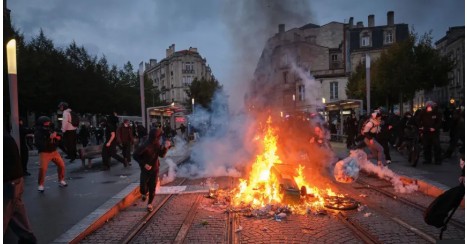
PARIS: French authorities arrested more than 1,300 people after hundreds of thousands took part in nationwide protests on Saturday over the cost of living and poor school conditions, with clashes erupting in several cities despite a massive security deployment.
The demonstrations were largely peaceful initially, but police later fired tear gas and water cannon to disperse crowds in Paris and other cities. Protesters erected and set fire to barricades in Marseille, while groups in Bordeaux removed boards from buildings to block streets.
Although violence broke out in several locations, authorities said they had so far avoided a repeat of the widespread looting and arson that followed demonstrations the previous weekend.
France’s Interior Ministry estimated that around 410,000 people joined Saturday’s protests, while trade unions put the turnout at approximately 800,000. Some 70,000 police officers were deployed nationwide amid concerns that the demonstrations could again descend into widespread disorder.
The ministry said 53 police officers were injured in clashes across the country. Interior Minister Laurent Nuñez said two people were seriously injured, one in Toulouse in southwestern France and the other in Clermont-Ferrand in the country’s central region.
A 20-year-old protester in Toulouse reportedly lost several fingers when an explosive device went off nearby, according to Franceinfo, which cited the medic who treated him.
President Emmanuel Macron had announced earlier in the week that only demonstrations organised by recognised trade unions would be permitted, as the government sought to contain the unrest while allowing organised protests to proceed.
Hundreds of people have been jailed following expedited court hearings for offences including vandalism, arson and looting.
In Paris, clashes erupted at the end of a march from Porte d’Italie towards Porte de Vincennes. Police deployed specialised units as masked youths allegedly threw projectiles, erected makeshift barricades and smashed the windows of a car dealership.
Nuñez said several thousand radical activists had gathered at the rear of the march, including around 500 people identified by authorities as rioters.
The Interior Ministry reported 142 arrests in the French capital on Saturday, less than half the number recorded there on the same day the previous week.
In Marseille, protesters set fire to rubbish bins and makeshift barricades, using metal sheets to block streets. A law enforcement vehicle was seen moving through a burning barricade in the southern port city.
In Bordeaux, some demonstrators wearing dark clothing and face coverings removed boards from a building to construct street barricades. Police also used tear gas in Lyon to disperse a crowd that had gathered in an area declared off-limits by local authorities.
A protester in Lyon said the police intervention began shortly after a group of around 150 people, mostly secondary school and university students, assembled in the area.
As unrest continued into the early hours of Sunday, authorities in Bouches-du-Rhône, the administrative region that includes Marseille, reported that seven businesses had been looted or damaged.
The protests reflect growing frustration over rising living costs, taxation, public services and conditions in schools. Student demonstrations that began last month have expanded into a wider movement involving trade unions and other groups opposed to the government’s policies.
The initial protests erupted at a high school in Créteil, southeast of Paris, over staff shortages. Demonstrations, classroom strikes and school blockades subsequently spread to other parts of the country.
Students have complained about underfunded schools, deteriorating facilities and insufficient staff, particularly in lower-income neighbourhoods. Some have also demanded changes to the university admissions system, which they consider complicated and unfair.
The movement has since broadened to include grievances over fuel prices and the rising cost of living.
“We really want a change in France,” a teenage protester told the BBC.
Another demonstrator in Paris said people had taken to the streets because they were frustrated and felt they had been suffering since Macron came to power.
Two masked teenage protesters said many young people felt abandoned by the government. One condemned looting but argued that poverty and what he described as police violence had contributed to the unrest.
The protesters said demonstrations would continue until the government responded to their demands.
The unrest has unfolded against an increasingly polarised political backdrop ahead of France’s next presidential election.
Macron and his government have faced criticism from political figures on both the right and the left over their handling of the protests. Right-wing politicians have condemned the rioting, while left-wing leaders have backed the union-led demonstrations and questioned the police response.
Jean-Luc Mélenchon of the left-wing La France Insoumise party accused French media of giving insufficient attention to peaceful protests and alleged that police tactics had provoked disorder. His remarks reflected the deep divisions over how the government has responded to the demonstrations.
Meanwhile, around 13,000 people attended a peaceful rally against the right-wing National Rally party in Orléans, in north-central France.
Authorities have sought to prevent further violence through restrictions on demonstrations, increased police deployments and overnight curfews in Paris and other cities.
The government is also facing pressure to address the economic and social grievances driving the protests while preventing groups involved in violence from disrupting peaceful demonstrations.
Protests and clashes were also reported in other European countries on Saturday.
In Barcelona, Spain, more than 120 people were arrested after a student demonstration descended into what local authorities described as gratuitous violence.
In Tirana, the Albanian capital, riot police fired tear gas to disperse thousands of anti-government demonstrators. Clashes were also reported in Brussels, Belgium.
In Milan, Italy, a major security operation involving police and hundreds of soldiers prevented protesters from gathering, amid fears of a repeat of the previous week’s violence, when demonstrators set fires, smashed windows and looted shops.
The latest unrest in France follows demonstrations last weekend that drew around 550,000 people, according to the figures cited in the report. More than 2,500 arrests were made in the aftermath.
The earlier disorder affected more than 2,000 shops and businesses across France, with the country’s Chambers of Commerce and Industry estimating the damage at hundreds of millions of euros. Around 1,000 police officers were reportedly injured, while authorities imposed overnight curfews in Paris and other cities.
Saturday’s demonstrations showed that, despite the extensive security measures, public anger remains high. The government now faces the challenge of restoring calm while addressing the concerns of students, workers and households struggling with rising costs.