Play store

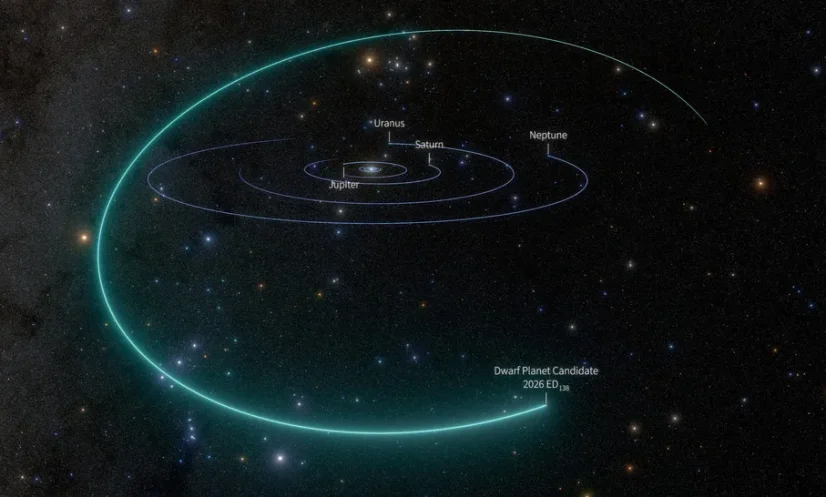
The powerful Vera C Rubin Observatory has detected a potential new dwarf planet orbiting the Sun beyond Neptune, in the icy outer reaches of the solar system.
The object, designated 2026 ED138, is estimated to be between 600 and 1,500 kilometres in diameter, potentially large enough for its own gravity to shape it into a sphere, a key characteristic of dwarf planets.
If confirmed, it would become the sixth officially recognised dwarf planet in the solar system, joining Pluto, Ceres, Eris, Haumea and Makemake.
The discovery was made by Matthew Holman of the Center for Astrophysics | Harvard & Smithsonian. He identified the object on October 13 while analysing previously collected data from the Rubin Observatory using a search programme developed with his colleague Kevin Napier.
Holman said he was initially surprised by the discovery and began checking whether the search programme had produced an error.
Further examination confirmed that the observatory had detected 2026 ED138 on 30 occasions across 20 nights between March 4 and July 11 this year.
Researchers also found that the Dark Energy Camera, installed on the Víctor M Blanco 4-metre Telescope at the Cerro Tololo Inter-American Observatory in Chile, had observed the object as far back as 2016.
The newly identified object is currently about 46 astronomical units from the Sun, meaning it is roughly 46 times farther from the Sun than Earth. This places it beyond Pluto’s average distance of around 40 astronomical units.
Its orbit is tilted approximately 25 degrees relative to the plane of the solar system, suggesting that a gravitational interaction with Neptune may have altered its orbital path, scientists said.
However, its classification as a dwarf planet has yet to be confirmed. Astronomers need more precise measurements of its size, which will require infrared observations, potentially using NASA’s James Webb Space Telescope.
The Vera C Rubin Observatory, located atop Cerro Pachón in northern Chile, has an 8.4-metre primary mirror and the world’s largest digital camera designed for astronomical observations, with a resolution of 3.2 billion pixels.
After achieving first light in April 2025, the observatory began its 10-year Legacy Survey of Space and Time (LSST) in June 2026. The project will image the entire southern sky every few days, creating a detailed time-lapse record of the universe.
The observatory has already identified more than 11,000 previously unknown asteroids, and scientists expect it to uncover many more objects in the solar system.
If confirmed as a dwarf planet, 2026 ED138 would join a small group of distant worlds and provide further insight into the formation and evolution of the outer solar system.
Scientists believe the observatory’s repeated surveys over the next decade could reveal additional undiscovered worlds beyond Neptune.