Play store

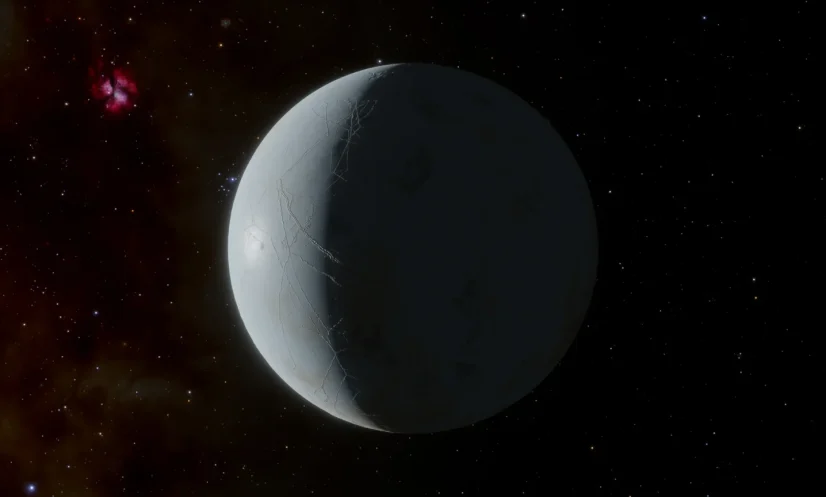
Astronomers have found new evidence suggesting that a second hidden planet, dubbed Planet X2, may exist in the distant outskirts of the Solar System, potentially reshaping our understanding of how the planetary system evolved.
The hypothetical world, believed to have a mass roughly one to two times that of Earth, could explain the unusual orbits of some distant icy objects beyond Neptune that cannot be fully accounted for by the gravitational influence of the known planets.
The discovery does not refer to the much-discussed Planet Nine hypothesis. Instead, researchers suggest that Planet X2 could be an additional, separate world, meaning the Solar System might contain two undiscovered planets.
The clues come from two unusual populations of trans-Neptunian objects (TNOs). One group follows highly tilted orbits, while the other consists of objects whose closest approaches to the Sun are far beyond even Pluto’s orbit.
Scientists say computer simulations of the Solar System’s 4.5-billion-year evolution have struggled to reproduce these orbital patterns using only the four known giant planets — Jupiter, Saturn, Uranus and Neptune.
To investigate the mystery, an international research team led by Patryk Sofia Lykawka of the University of Southern Queensland in Australia and Kindai University in Japan, along with Pedro Bernardinelli of the University of Washington in the United States and planetary scientist Jonti Horner, conducted detailed computer simulations.
The researchers compared models featuring only the four known giant planets with those incorporating an additional distant planet. They examined how the different planetary configurations influenced the distribution and movement of icy objects in the outer Solar System.
The simulations showed that adding another planet could produce populations of objects with highly inclined and detached orbits, closely resembling those observed by astronomers.
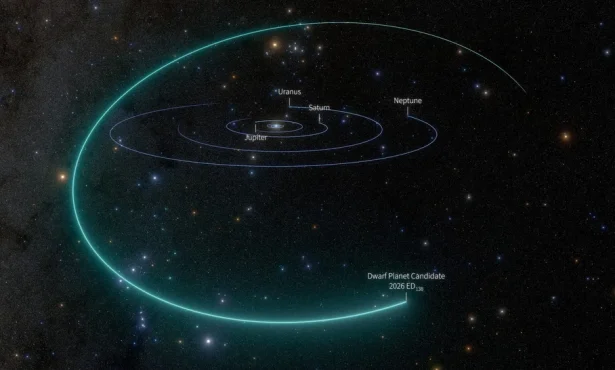
The best-fitting model suggests a planet with a mass of approximately one to two Earths, orbiting at an average distance of 350 to 500 astronomical units (AU) from the Sun. One astronomical unit is the average distance between Earth and the Sun.
The hypothetical planet would never approach closer than about 200 AU to the Sun, making it extremely difficult to detect with existing telescopes.
At Neptune’s average distance of 30.1 AU, sunlight is already about 900 times weaker than it is on Earth. At the proposed distance of Planet X2, the amount of sunlight available to illuminate an object would be dramatically lower, making observations particularly challenging.
Planetary scientist Jonti Horner compared the unusual orbital patterns to footprints in the snow, suggesting they could indicate the presence of an otherwise unseen object.
“If this planet exists, it could change how we understand the history of our Solar System and how its most distant objects came to follow such unusual orbits,” Lykawka said.
The Planet X2 hypothesis is separate from the Planet Nine theory, which seeks to explain another set of unusual orbital patterns among distant Solar System objects.
A 2025 analysis estimated that Planet Nine could have a mass of around 4.4 times that of Earth and orbit at an average distance of approximately 290 AU from the Sun.
Because the two hypothetical planets could explain different orbital anomalies, researchers say both might exist simultaneously.
However, Planet X2 remains hypothetical. Its existence has not yet been confirmed through direct observation, and further studies will be needed to establish whether the unusual orbital patterns really point to another hidden world.