


 Play store

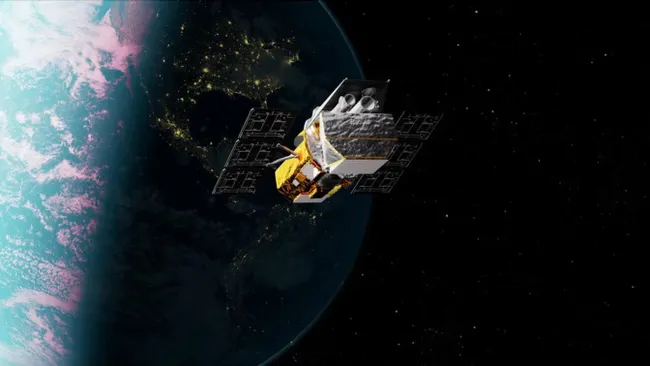
NASA’s Swift space telescope is expected to re-enter Earth’s atmosphere in the coming days after a failed rescue mission left it unable to maintain its orbit.
The Neil Gehrels Swift Observatory will make an uncontrolled descent, ending more than two decades of scientific operations studying gamma-ray bursts and other cosmic phenomena.
Launched in November 2004, Swift observed some of the universe’s most powerful explosions using three instruments: the Burst Alert Telescope (BAT), the X-Ray Telescope (XRT) and the Ultraviolet/Optical Telescope (UVOT).
On October 20, NASA reported that the observatory’s orbit had dropped to 171 miles (275 kilometres) above Earth. The spacecraft, weighing around 1,500 kilogrammes, could no longer compensate for increasing atmospheric drag.
It subsequently entered safe mode, and its operations team at Pennsylvania State University sent a command that effectively ended its mission ahead of its expected re-entry.
The exact time and location of the spacecraft’s return remain uncertain.
Despite the failed attempt to raise its orbit, experts believe most of the observatory will burn up in the atmosphere, posing little risk to people on the ground.
Darren McKnight, a senior technical fellow at space-tracking company LeoLabs, said Swift was likely to disintegrate sufficiently during re-entry to avoid causing casualties. However, some internal components of its X-ray and optical telescopes could survive the descent.
Aerospace engineer Dean Sladen said the spacecraft would begin heating up and glowing as it descended to around 120 kilometres above Earth. Its solar panels and antennas would likely break away first, followed by the main body at around 78 kilometres, with most components melting or vaporising.
Any surviving debris could fall within a band extending about 21 degrees north and south of the equator, an area that includes large ocean regions as well as parts of Africa, South and Southeast Asia and Latin America.
The incident comes amid a growing number of satellite re-entries as the number of objects in low Earth orbit increases.
McKnight said the number of objects re-entering Earth’s atmosphere annually has increased tenfold over the past five years, partly due to the expansion of satellite constellations and regular replacement of space technology.