


 Play store

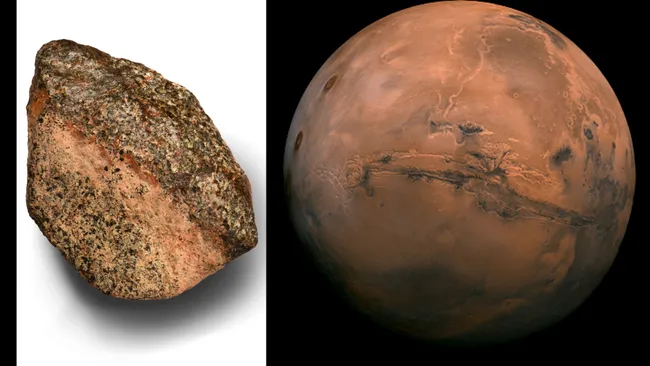
A rare, rose-coloured meteorite discovered in the Sahara Desert could provide important clues about Mars’ ancient geological history, including how water shaped the planet’s early crust.
Named Teghaza 001 after the salt plain in Mali where it was discovered in 2022, the meteorite weighs about 800 grams and formed more than 4.1 billion years ago. It was blasted off Mars by an asteroid impact before eventually reaching Earth.
It is considered one of the three oldest Martian meteorites ever discovered, according to a study funded by NASA.
Researchers say its unusual mineral composition and exceptional age offer a rare opportunity to investigate the formation of Mars’ early crust and the effects of water on volcanic rocks.
“We realised this meteorite is really unique,” said Yang Liu, lead researcher at NASA’s Jet Propulsion Laboratory in Southern California. One reviewer of the research paper described it as a “Rosetta Stone for Mars”.
Unlike many other Martian meteorites, Teghaza 001 contains a distinctive combination of igneous minerals and textures that preserve evidence of its complex geological history.
Its mineral composition resembles materials observed in the southern highlands of Mars by NASA’s Mars Reconnaissance Orbiter. Although scientists have not identified its exact place of origin, they have shortlisted 13 possible locations on the Red Planet.
“This is really our first piece of Martian crust from a part of Mars we’ve never had a sample of before,” said research team member Lee Saper of NASA’s Ames Research Center.
He said the meteorite records interactions between water and rocks and may also preserve traces of the Martian atmosphere from a period when the planet was losing water.
Scientists initially identified the rock as Martian through its oxygen isotope composition. They subsequently examined tiny zircon crystals embedded in it to determine its age.
Using a specialised rubidium-strontium dating technique, researchers analysed individual mineral grains on the meteorite’s surface while preserving the sample for future studies.
The findings indicate that water altered the meteorite around 4.1 billion years ago, suggesting the rock itself formed even earlier.
Mineral and chemical evidence points to interactions between liquid water and Mars’ ancient crust, offering insights into the planet’s early water cycle and gradual loss of atmospheric water.
Researchers believe further analysis of the meteorite could reveal more about how water influenced the evolution of Mars.
The study, which also marks the first use of rubidium-strontium dating to analyse an ancient Martian meteorite, was published on October 29 in the journal Science.
A separate study examining the meteorite’s water content was published in Science Advances on June 10.
“We’ve only scratched the surface,” Liu said.