


 Play store


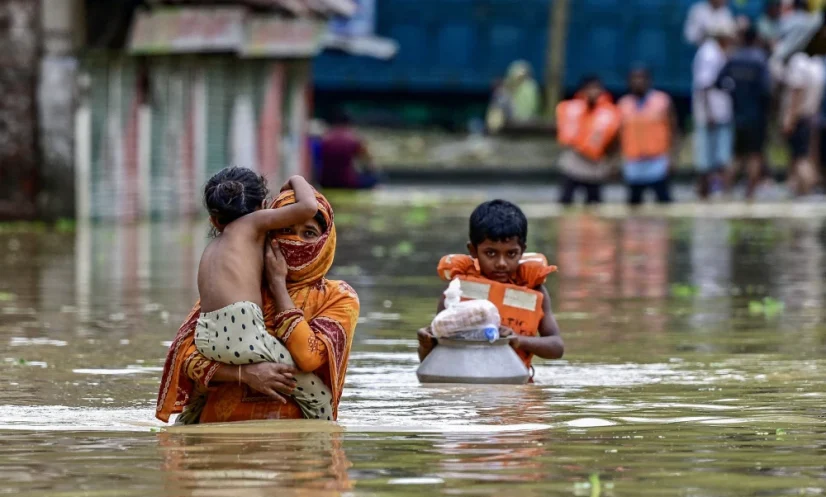
Very often monsoon reminds us of a familiar reality: floods are inevitable, but the widespread loss of lives, displacement, destruction of homes, and economic hardship that often accompany floods are not inevitable — they can be greatly minimized through a better planning and preparedness. There is no exception to the menace this year also as the floods have already started taking a heavy toll on the life and livelihoods of the people. By this time, floods and landslides have killed 30 people in five districts of Chattogram division.
As rivers swell and heavy rainfall inundate low-lying areas, images of submerged homes, damaged roads, stranded families and disrupted livelihoods dominate the headlines.
Bangladesh is one of the world’s most climate-vulnerable countries. Its geographical location, vast river network and low-lying delta make seasonal flooding unavoidable. Climate change has intensified this reality by increasing the frequency of extreme rainfall and unpredictable weather patterns. No government can prevent floods altogether.
However, the extent of human suffering and economic loss depends largely on how effectively a country prepares before the impending disaster strikes.
The economic stakes of flooding are enormous. Bangladesh suffers around US$3 billion in disaster-related losses every year, with floods accounting for a significant share.
More than 6.3 million people are affected by climate-related disasters annually. These figures underscore that flooding is no longer just a seasonal inconvenience; it is a recurring development challenge with profound economic and social consequences.
The devastating floods of August 2024 offered another stark reminder. About 5.8 million people were affected across 11 districts, more than 500,000 people were forced into emergency shelters and 71 people lost their lives.
The floods caused an estimated Tk 144 billion (US$1.2 billion) in economic losses and damaged nearly 296,852 hectares of cropland, disrupting the livelihoods of millions of farming households. Such losses cannot simply be viewed as unavoidable acts of nature.
Our country has earned international recognition for dramatically reducing cyclone-related deaths through sustained investments in early warning systems, cyclone shelters and community preparedness. This success demonstrates that proactive planning can save lives and properties. A similar long-term approach is now urgently needed for flood management.
Unfortunately, flood response in Bangladesh still follows a familiar cycle. Warnings are issued, floodwaters rise, emergency relief is distributed and, once the water recedes, public attention gradually fades. Yet the underlying vulnerabilities remain. The next monsoon brings the same scenes of displacement, damaged infrastructure and interrupted livelihoods. This pattern suggests that flood management remains driven more by emergency response than long-term resilience.
Early warning systems have improved considerably. Weather forecasts and river-level predictions are more accurate than ever. However, warnings are effective only if they reach vulnerable communities in time and people have the means to act on them. A warning offers little protection if families have nowhere safe to relocate, farmers cannot safeguard their crops or local authorities lack the capacity to implement emergency plans.
Infrastructure remains another weak link. In many flood-prone districts, embankments are poorly maintained, drainage systems are inadequate and roads are built without sufficient consideration for changing climate conditions.
Rapid, often unplanned urbanisation has also worsened waterlogging in cities, where blocked canals and encroached wetlands prevent rainwater from draining naturally. These are not merely environmental problems; they are failures of planning and governance.
Effective flood management also requires stronger coordination among government agencies. Water resources, disaster management, agriculture, local government and infrastructure development are often handled by separate institutions with overlapping responsibilities.
Without integrated planning and regular information-sharing, valuable time and resources are lost. Climate adaptation cannot succeed through fragmented initiatives; it demands a coordinated national strategy.
Local communities should not be viewed merely as victims waiting for assistance. People living in flood-prone areas possess generations of practical knowledge about seasonal flooding. Their experience should inform local disaster planning, infrastructure design and adaptation measures. Community participation not only improves preparedness but also strengthens public trust in government initiatives.
Agriculture deserves particular attention. Floods continue to threaten food production and rural incomes. Promoting flood-tolerant crop varieties, expanding agricultural insurance, improving irrigation management and supporting climate-smart farming would significantly reduce economic losses while strengthening national food security.
Technology also offers new opportunities. Satellite monitoring, digital mapping, mobile alerts and real-time data sharing can transform disaster preparedness. Bangladesh has made encouraging progress in digital governance, but these tools should become integral to flood management at both national and local levels.
Ultimately, the greatest challenge is political. Disaster preparedness rarely attracts the same attention as emergency relief because its success is measured by disasters that do not happen. Yet investing in resilience is far more cost-effective than rebuilding homes, repairing infrastructure and restoring livelihoods after every flood.
Bangladesh has repeatedly shown that proper planning and community engagement can reduce disaster risks. Floods will always remain part of the country’s geography. The real test of governance is not how quickly authorities respond after floodwaters rise, but how effectively they reduce risks before disaster strikes.
The views expressed in this article are the author’s own and do not necessarily reflect Sarabangla English Edition’s editorial stance.