Play store

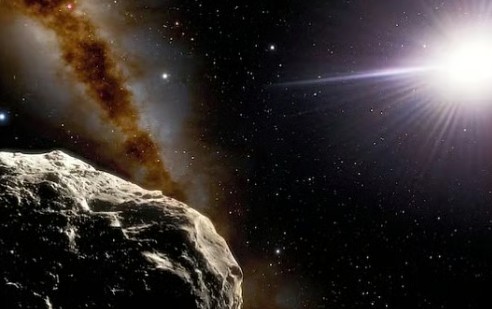
Five asteroids are making close approaches to Earth over two days, with four passing near the planet on November 19 and another expected to fly past on November 20.
Although the space rocks vary in size, all five will remain at safe distances and pose no threat to Earth, according to the US space agency NASA.
However, all five fall into the category of potentially hazardous asteroids under NASA’s classification because their orbits bring them within a defined distance of Earth’s orbit.
Five asteroids making close approaches
According to NASA data, the first asteroid, designated 2026 VA11, passed Earth on November 19. It has an estimated diameter of 40 feet and came as close as 3.35 million kilometres to the planet.
The second asteroid, 2026 TB84, is approximately 210 feet across, roughly the size of an aircraft. It passed at a closest distance of 4.65 million kilometres.
The third object, 2007 WK3, measures about 64 feet in diameter and passed Earth at a distance of approximately 5.47 million kilometres.
The fourth asteroid, 2018 NE1, is around 230 feet across. It made its closest approach on November 19 at a distance of 6.39 million kilometres.
The fifth asteroid, 2026 VD6, is expected to make its closest approach on November 20, passing approximately 4.02 million kilometres from Earth.
How NASA monitors asteroids
NASA’s Centre for Near-Earth Object Studies (CNEOS), operated by the agency’s Jet Propulsion Laboratory, monitors asteroids and comets that approach Earth.
The centre tracks their orbits, sizes, distances and speeds to assess potential risks and predict when they may pass close to the planet.
Under NASA’s definition, asteroids and comets whose orbits bring them within 195 million kilometres of the Sun are classified as near-Earth objects. Their paths can bring them relatively close to Earth’s orbit.
Monitoring these objects is important for identifying potential threats and preparing for possible impacts.
However, despite advances in observation and tracking technology, some smaller asteroids can occasionally enter Earth’s atmosphere or strike the planet before scientists have an opportunity to issue advance warnings.