Play store

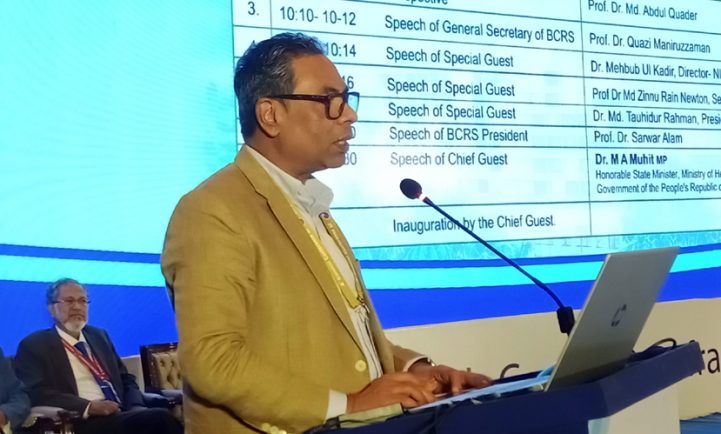
The government will revive and restructure eye banks across the country to prevent corneal blindness and restore sight to affected people, State Minister for Health and Family Welfare Dr MA Muhit has said.
He also stressed the need to raise public awareness and encourage people to donate their corneas after death to ensure an adequate supply for transplantation.
He made the remarks while addressing the inaugural session of the fourth biennial conference of the Bangladesh Cornea and Refractive Society at Pan Pacific Sonargaon Hotel in Dhaka on Thursday.
The state minister said ophthalmic epidemiology and public health had long been areas of interest in his research and teaching career.
Although cataracts remain the leading cause of blindness in Bangladesh, corneal blindness was historically another major cause, he said.
Two to three decades ago, vitamin A deficiency caused widespread corneal blindness among children. However, the prevalence of such cases declined significantly after the government introduced vitamin A capsule distribution alongside its Expanded Programme on Immunisation (EPI), he added.
Currently, eye infections and injuries are the major causes of corneal blindness, the minister said.
He noted that the government had passed the Human Organ Transplantation Bill in the first session of parliament after taking office, bringing corneal transplantation under a legal framework.
Bangladesh currently has around 50 cornea specialist surgeons, of whom 25 regularly perform corneal transplants. However, due to a shortage of donated corneas, most procedures depend on imported corneas, making treatment expensive and complicated for patients, he said.
Citing statistics, Muhit said around 15,000 people in Bangladesh suffer from bilateral corneal blindness, while another 50,000 are at risk of developing the condition.
He also said nearly 2,000 young people injured during the 2024 mass uprising had lost their eyesight, with a significant proportion suffering corneal damage. Many of them could regain their vision through corneal transplantation, he added.
The minister said a large proportion of corneal blindness caused by infections and injuries was preventable.
He called for a comprehensive action plan involving Sandhani, the National Eye Donation Society, eye banks and international organisations to address the problem.
Public awareness campaigns through the mass media and social media would also be necessary to encourage posthumous cornea donation, he said.
The government would provide all possible support to expand advanced medical training and research opportunities for doctors, he added.
Acting Director of the National Institute of Ophthalmology Dr Mehbub Ul Qadir, Bangladesh Cornea and Refractive Society President Prof Dr Sarwar Alam, General Secretary Prof Dr Kazi Moniruzzaman, Ophthalmological Society of Bangladesh President Dr Touhidur Rahman and Secretary General Dr Zinnurain also spoke at the event.
Senior eye specialists from across the country attended the conference.