


 Play store

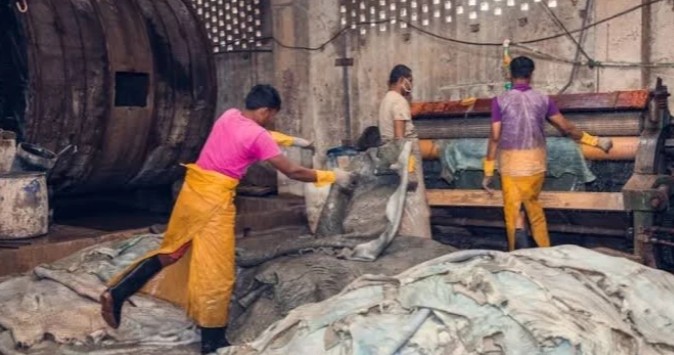
DHAKA: Bangladesh’s leather industry has called for a Tk 5,000 crore special fund to revive closed factories and restore the sector’s competitiveness, as a new industry-focused organisation unveiled a 13-point proposal for sustainable development.
The Leather Foundation of Bangladesh (LFB), a non-profit national industrial development organisation, was formally launched on Saturday with a commitment to promote sustainable growth, develop skilled manpower, attract foreign investment and improve coordination among industry stakeholders.
The foundation announced its vision, action plan and 13-point proposal at a programme at the Jatiya Press Club.
Speaking at the event, LFB President Sadat Hossain Salim said establishing a Central Effluent Treatment Plant (CETP) was essential for ensuring environmental compliance but would not, by itself, resolve the broader challenges facing the leather industry.
Citing Khulna’s Super Ex Leather as an example, he said the factory would not have fallen into crisis if an effluent treatment plant alone could guarantee the industry’s sustainability.
He called for effective government support in chemical supplies, import-export operations and other business activities, taking into account the practical experiences of entrepreneurs and traders.
LFB Secretary General and Founder M Mufazzal Ibne Mahfuz said improving coordination among different segments of the leather industry, trade associations, entrepreneurs and technical institutions was one of the foundation’s key objectives.
Presenting the keynote paper, Joint Secretary General Engineer A Fattah Al Monjur Asif said Bangladesh had abundant domestic raw materials and a hardworking workforce, but shortages of skilled mid-level professionals, limited access to modern technology and difficulties in obtaining Leather Working Group (LWG) certification were preventing the country from achieving its desired share of the global market.
He said the foundation would operate through six permanent programme wings to implement its objectives.
Its first-year action plan includes providing skills development training to 1,000 workers, helping 30 factories develop into model green factories and introducing educational scholarships for workers’ children.
The foundation also plans to work with foreign agencies to attract overseas investment and expand Bangladesh’s access to international markets, he added.
Among the major demands in its 13-point proposal are the modernisation of the Savar CETP and construction of two additional CETPs to improve environmental compliance across the sector.
The proposal also calls for establishing one or two specialised industrial parks for leather goods and footwear, along with four to five new leather industrial estates.
Other demands include setting up a full-fledged university specialising in leather and footwear, establishing 10 to 15 government rawhide storage hubs and cold storage facilities across the country, and making the use of locally produced leather and jute mandatory in footwear and related equipment procured for government forces.
Senior Vice President Advocate Shafiqur Rahman stressed the need for easier access to loans on flexible terms and business-friendly policies to support leather traders.
Vice President Maulana Mahbubul Haq called for technical training in hide preservation and primary processing beyond traditional salting methods, with support from the ministries of industries and commerce and the Islamic Foundation.
Leaders of the foundation, representatives of leather goods manufacturers’ associations and the Bangladesh Hide and Skin Merchants Association, as well as leather entrepreneurs and traders, attended the programme.