


 Play store

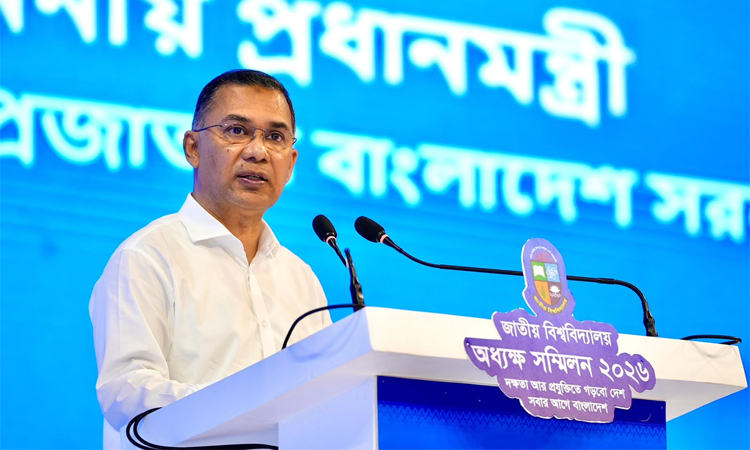
DHAKA: Prime Minister Tarique Rahman on Saturday called on college principals to critically assess the quality of education at their institutions and keep campuses free from political factionalism and personal rivalries, warning that political differences must never undermine teaching, discipline or student safety.
He also stressed the need to transform the country’s education system through modern technology, practical skills, research-based teaching and greater coordination between educational institutions and industries.
“Differences in political opinion and belief are natural in a democratic society. But teachers must remain alert and conscious so that such differences do not disrupt the learning environment, teaching activities, administrative discipline and the safety of students,” he said.
The Prime Minister was speaking as the chief guest at a conference of principals of the National University (NU) at Shaheed Suhrawardy Indoor Stadium in Mirpur on Saturday morning.
Principals from all 2,318 colleges affiliated with the university attended the conference, held under the theme “Building the country through skills and technology, Bangladesh first”.
Describing the responsibilities of a college principal, Tarique said the head of an institution was not merely its administrative chief but also its leader, moral guide and one of the architects of the future generation.
“The overall progress of an institution depends largely on his or her merit, competence, decisions, prudence and foresight,” he said.
Recalling the contribution of late former Prime Minister Begum Khaleda Zia, he said she had established the National University on October 21, 1992, to expand higher education opportunities for people in both urban and rural areas.
The number of colleges affiliated with the university had since grown to nearly 2,500, he said, adding that the expansion of institutions and student enrolment should prompt a serious assessment of improvements in educational standards.
“Although the number of colleges and students has increased since its establishment, we need self-criticism about how much the quality of education has actually improved,” he said.
Observing that the education sector, like other sectors, had suffered during the previous fascist regime, Tarique said collective efforts were now needed to build a modern, quality-oriented and time-befitting education system in a fascism-free Bangladesh.
He said the government was taking necessary plans and initiatives, but college principals would have to play a leading role in implementing them.
Emphasising teacher training as essential to modernising education, the Prime Minister called for a shift away from traditional teacher-centred methods towards student-centred and research-based teaching.
“Instead of the prevailing teacher-centred education, student-centred and research-based teaching methods must be introduced. The ‘Training of Trainers’ programme can play an effective role in this regard,” he said.
Warning of the consequences of failing to adapt to technological changes, he said the number of educated people holding academic certificates might continue to rise without any corresponding reduction in unemployment if teachers and students could not adjust to modern education methods.
He identified the lack of practical and technical knowledge alongside academic qualifications as a major reason for graduate unemployment.
The Prime Minister urged higher education institutions to move beyond conventional teaching approaches, noting that artificial intelligence, robotics, big data, the Internet of Things, blockchain, automation, genetic engineering, cybersecurity and 5G technology were transforming the future of work.
“On one hand, many old professions are disappearing because of these technologies, and on the other, new fields of employment are emerging. In this reality, there is no alternative to building a technology-based, innovation-oriented, skills-based and employment-friendly education system,” he said.
Stressing stronger links between education and industry, Tarique said educational institutions should provide the foundation of knowledge while industries should help translate that knowledge into practical skills.
He suggested allowing experienced and skilled industry professionals to teach at colleges and universities as guest lecturers. He also urged entrepreneurs to expand internship programmes, industrial attachments and hands-on training opportunities for students.
“If students can acquire goal-oriented skills and experience during their academic life, they will be able to become entrepreneurs themselves and create jobs for others instead of waiting for jobs,” he said.
The Prime Minister also stressed that technical education should go hand in hand with humanistic learning.
He said education should not be limited to preparing students for employment but should also develop their human values, creativity, reasoning and leadership through literature, philosophy, history, science, social science and cultural activities.
He called for opportunities to learn Arabic, Mandarin, Japanese, Korean, French and German alongside English, while urging colleges to introduce career counselling, skills development programmes, language clubs and entrepreneurship initiatives.
Tarique said the government was also concerned about protecting the interests of educational institutions and teachers.
He urged the Ministry of Education, the Directorate of Secondary and Higher Education, the Non-Government Teachers’ Registration and Certification Authority (NTRCA) and the National University authorities to work together to assess teacher shortages at individual colleges, fill vacant posts, recruit and deploy teachers, and arrange training and skills development programmes.
Colleges with adequate rooftop space should also consider installing solar power systems, he said.
Calling for greater environmental awareness, the Prime Minister urged teachers and students to work together to keep their institutions, homes and surroundings clean and strengthen tree-planting programmes. He noted that nearly 200,000 trees had already been planted at educational institutions.
He also called on every college to adopt a positive and supportive approach towards financially disadvantaged, marginalised and students with special needs.
“The government wants to build a Bangladesh that is rich in knowledge and virtue, self-reliant in work, advanced in humanity and will stand tall with its own dignity on the world stage,” he said.
He wished success for the National University’s ‘One Student, One Tree’ programme.
Earlier, the programme began with the national anthem and recitation from the Holy Quran, followed by a one-minute silence in memory of the martyrs of the Liberation War and the July 2024 mass uprising.
A documentary highlighting the social activities of Shaheed President Ziaur Rahman and late Begum Khaleda Zia was screened.
NU Vice-Chancellor Professor Dr A S M Amanullah presented the keynote paper and handed a sapling to the Prime Minister on behalf of the university.
A documentary was also unveiled on ‘Durjog Theke Shosti’ (Relief from Disaster), an application developed by NU student Shahjahan Molla.
The app provides emergency alerts and assistance during disasters and earthquakes, along with information on commodity prices, transport, health warnings and government services.
Around 40 lakh students are enrolled at the 2,318 colleges affiliated with the National University, accounting for approximately 70 per cent of all higher education students in the country.
Education Minister Dr A N M Ehsanul Hoque Milon, Prime Minister’s Education Adviser Mahdi Amin and Senior Secretary of the Secondary and Higher Education Division Abdul Khaleque attended the conference as special guests.
Chaired by NU Vice-Chancellor Professor Dr A S M Amanullah, the programme was also addressed by Pro-Vice-Chancellor Professor Dr Mohammad Ali Jinnah, Treasurer Professor Dr Md Nazmul Hossain, Bogura Government Azizul Haque College Principal Professor Md Mahfuzul Islam and Lalmatia Government Mahila College Principal Sultana Mahmuda Yasmin.