


 Play store

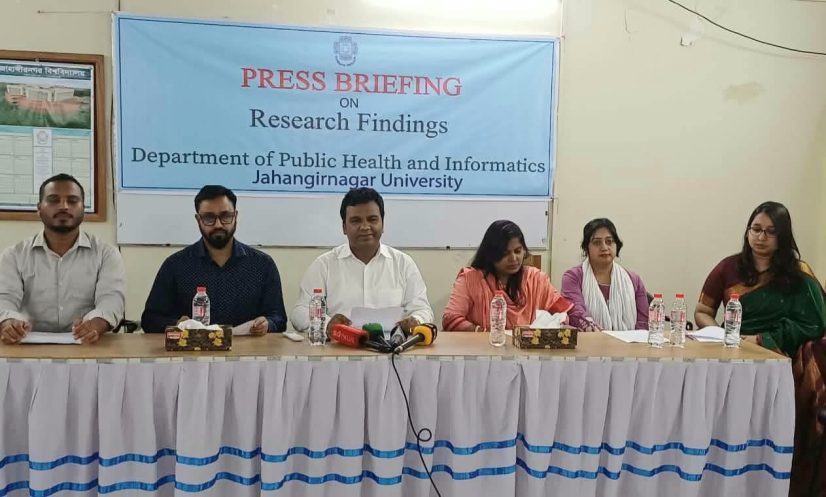
JU Correspondent: Exposure to fine particulate matter (PM2.5) pollution causes an estimated 88,240 premature deaths every year in six major Bangladeshi cities and inflicts an annual economic loss of nearly US$23 billion (about Tk 280,000 crore), equivalent to around 5 percent of the country’s gross domestic product (GDP), according to a new study by Jahangirnagar University (JU).
The findings were unveiled at a press conference on Wednesday at the Department of Public Health and Informatics by its Chairman and Associate Professor, Dr Md Sakhawat Hossain.
The study, conducted by the university’s Climate Change, Air Quality and Health Research (C2AHR) Unit and recently published in the international journal Pollution, analysed PM2.5 exposure data from Dhaka, Chattogram, Rajshahi, Khulna, Sylhet and Barishal.
According to the research, air pollution is responsible for an average of 242 premature deaths every day. Of the annual fatalities, about 37,519 are linked to cardiovascular diseases, 8,344 to chronic respiratory diseases and 811 to lung cancer.
Dhaka recorded by far the highest number of pollution-related deaths, with an estimated 68,703 fatalities annually. Chattogram ranked second with 11,202 deaths, followed by Rajshahi (2,827), Khulna (2,625), Sylhet (1,488) and Barishal (1,395).
The study also found that premature deaths associated with PM2.5 pollution increased steadily in all six cities between 2013 and 2021. In Dhaka alone, pollution contributed to an average of 3,484 additional deaths each year during the period, reflecting the city’s deteriorating air quality.
Presenting the findings, Dr Sakhawat Hossain said air pollution should no longer be viewed solely as an environmental issue but as a major public health and economic challenge.
“Our findings show that air pollution causes nearly 88,000 premature deaths annually and economic losses amounting to about 5 percent of Bangladesh’s GDP. Without immediate and effective interventions, both the health and economic burden will continue to rise,” he said.
The researchers said a large proportion of these deaths and economic losses could be prevented through strict enforcement of the World Health Organization’s air quality guidelines, significant reductions in PM2.5 emissions, stronger urban air quality management and evidence-based policymaking.
They urged the government to treat air pollution as a national public health priority, warning that delayed action would further increase the country’s health risks, economic losses and environmental challenges.