


 Play store

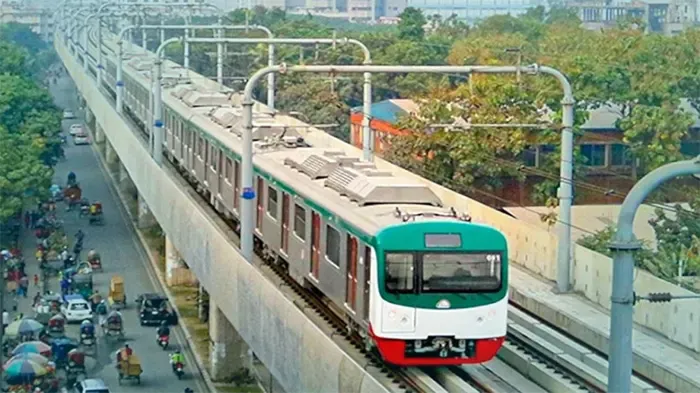
Serious safety flaws have been identified in Dhaka’s metro rail system, prompting authorities to form a nine-member committee to implement corrective measures following a court-ordered audit.
The investigation was launched after a fatal incident last year, when a bearing pad fell from the elevated track and killed a pedestrian.
Acting on a High Court directive, a safety audit was conducted, and its findings have recently been submitted to the Dhaka Mass Transit Company Limited (DMTCL) and the court.
According to the audit report, 730 bearing pads—more than 23 percent of those inspected—were found to be defective along the 21.26-kilometre MRT Line-6.
The committee also identified significant cracks in pier heads (the upper portions of pillars) and concrete foundations at multiple locations. In addition, corroded rail tracks, fastening components, and other equipment were detected.
The audit further revealed operational risks in the Overhead Catenary System (OCS), where insulated overlaps are producing frequent electrical sparks, raising concerns about potential fire hazards.
Passenger comfort has also been affected. The report highlights excessive vibration, jolting, and track-support issues, which have forced trains to operate below their designed speed.
Although the system was built for speeds of up to 110 km/h, trains are currently running between 60 and 90 km/h, with speeds dropping as low as 44–47 km/h in some sections.
After reviewing the report, the High Court directed DMTCL to implement 28 recommendations—eight short-term, ten medium-term, and ten long-term.
The court also instructed the authority to adopt six additional strategic measures for ongoing and future MRT projects.
In response, DMTCL has formed a nine-member committee tasked with overseeing the implementation of these recommendations, coordinating related activities, and monitoring overall progress.
Regular progress reports will be submitted to the High Court through the Road Transport and Highways Division and DMTCL’s legal representatives.
The findings have raised fresh concerns about the safety and performance of the capital’s flagship mass transit system.