


 Play store

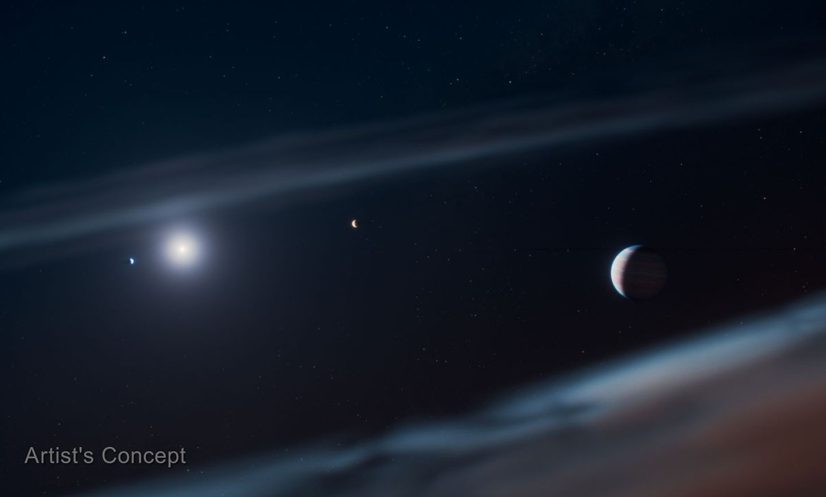
Astronomers using NASA’s James Webb Space Telescope have discovered a new giant planet outside our solar system.
The planet, named Beta Pictoris d, was found in the well-known Beta Pictoris star system, about 63 light-years from Earth.
The discovery gives the Beta Pictoris system three known planets, making it only the second planetary system where at least three planets have been directly detected.
Unlike the other two planets in the system, Beta Pictoris d was not found by its brightness. Instead, scientists identified it by detecting the unique chemical signature of its atmosphere. Researchers say this new method could help find more planets around distant stars in the future.
“This discovery adds another piece to an already fascinating planetary system,” said Aidan Gibbs, lead author of the study published in The Astrophysical Journal Letters. He said Beta Pictoris has long helped scientists understand how planetary systems form and change over time.
The Beta Pictoris system is about 23 million years old, making it very young compared with our 4.6-billion-year-old solar system. It is surrounded by a large disk of dust and debris left over from planet formation, giving astronomers a rare chance to study how young planets develop.
Scientists estimate that Beta Pictoris d is at least twice the mass of Jupiter, the largest planet in our solar system. It orbits its star at a distance similar to Neptune’s orbit around the Sun.
The planet was discovered by chance while researchers were using Webb’s Near-Infrared Spectrograph (NIRSpec) to study another planet, Beta Pictoris b.
“We weren’t looking for a new planet,” Gibbs said. “We were trying to understand one we already knew existed. Then this signal appeared in the data where we didn’t expect it.”
The telescope detected carbon monoxide in the planet’s atmosphere, producing a unique pattern in the light spectrum. By studying this pattern, scientists confirmed that the object was a planet orbiting Beta Pictoris and not a distant star or another celestial object.
Researchers believe the discovery shows the power of the James Webb Space Telescope and its advanced technology, which could lead to the discovery of many more hidden worlds beyond our solar system.