


 Play store

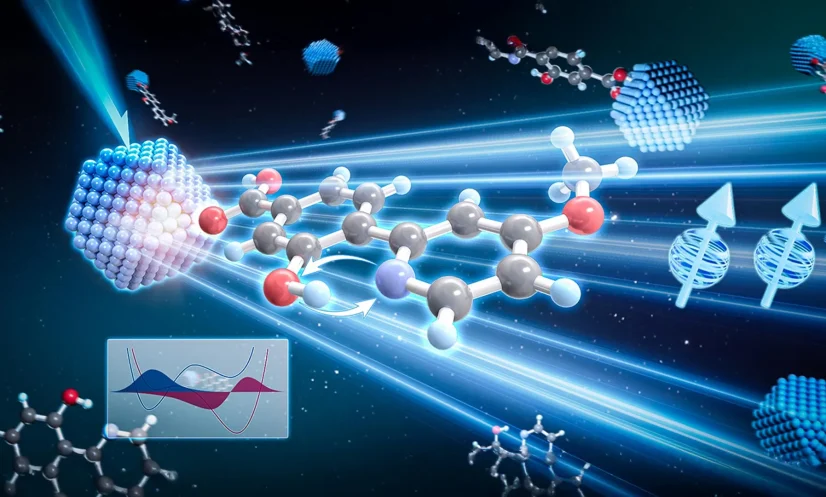
Researchers have discovered a previously unknown quantum mechanism that dramatically improves the transfer of triplet energy between quantum dots and nearby molecules, a breakthrough that could pave the way for more efficient solar cells, lasers and catalytic technologies.
The study, led by Prof. Kaifeng Wu of the Dalian Institute of Chemical Physics under the Chinese Academy of Sciences and published in Nature Materials, identifies a process called proton shuttle-assisted triplet energy transfer (PS-TET).
The newly discovered mechanism links proton motion with triplet energy transfer—a key process that governs how energy moves through both natural and artificial materials.
Scientists have long known that electrons and protons often move together in biological systems through a process called proton-coupled electron transfer (PCET), which plays a vital role in photosynthesis, cellular respiration and energy conversion. More recently, researchers identified proton-coupled singlet energy transfer (PCEnT).
The new study extends this understanding by revealing how proton movement can also control the transfer of triplet energy, an important but less understood energy transport pathway widely used in photochemistry and optoelectronic materials.
The researchers observed the phenomenon as energy traveled from zinc selenide (ZnSe)-based colloidal quantum dots to phenol-pyridine molecules attached to their surfaces.
When the quantum dots absorb light, they enter an excited state. A positively charged “hole” moves from the quantum dot to the phenol molecule while a proton simultaneously shifts from phenol to pyridine. An electron then transfers to the phenoxyl radical as the proton returns to its original position.
Although the proton ultimately ends up where it started, its temporary movement acts as a shuttle that significantly accelerates and improves the efficiency of triplet energy transfer.
The team found that this proton-assisted mechanism outperformed similar molecular systems lacking the proton shuttle. They also discovered that modifying the molecular structure with a trifluoromethyl group altered the sequence of electron and proton movements, providing another way to control energy flow.
One of the study’s most striking findings was that the transfer rate changed very little across different temperatures. This indicates that the proton is not moving through conventional heat-driven motion but instead travels by quantum tunneling, a phenomenon in which particles pass through energy barriers that classical physics would normally prevent.
Computer simulations supported this conclusion, showing that quantum mechanical interactions between proton vibrations help direct energy along the most efficient pathway.
According to Prof. Wu, the discovery has significant implications for technologies that rely on spin-triplet excited states.
Enhancing triplet energy generation could improve photoredox chemistry and environmental catalysis, where efficient energy transfer is essential. Conversely, suppressing unwanted triplet states could boost the performance of organic electronic devices such as solar cells, light-emitting devices and lasers.
The findings suggest scientists may now have a new molecular tool for controlling triplet energy. By incorporating a proton shuttle, they could enhance energy transfer where it is beneficial, or eliminate the shuttle to suppress the process when it reduces device performance.
The discovery offers fresh insight into how quantum effects can be harnessed at room temperature, opening new possibilities for designing next-generation energy, photonic and catalytic materials.