


 Play store

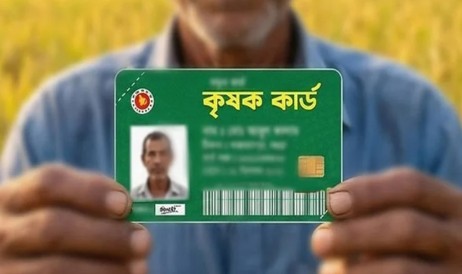
DHAKA: The government has set a target to distribute Farmer’s Cards among 2.4 crore farmers across the country over the next four years, with 43 lakh farmers expected to be brought under the programme in the current fiscal year (FY2026-27).
The initiative, introduced under the leadership of Prime Minister Tarique Rahman, aims to establish a comprehensive database of farmers and ensure the delivery of financial assistance, agricultural inputs and other essential services in a transparent and coordinated manner.
The programme is being implemented in phases across 14,180 agricultural blocks in 503 upazilas nationwide, with priority given to landless, marginal and small-scale farmers.
Activities including farmer registration, data collection and verification, bank account opening and card distribution are already underway. The programme was launched simultaneously in 77 upazilas across 56 districts on October 1, 2026.
According to official information, data from 19.25 lakh farmers has been collected across 1,681 agricultural blocks in 503 upazilas in 64 districts. Around nine lakh bank accounts linked to the Farmer’s Card programme have also been opened.
The government is using the initial implementation phase to assess operational requirements and expand the programme gradually, taking into account the capacity of participating banks and the progress of farmer registration.
Agriculture Secretary Md Salim Khan said the initiative was designed to bring farmers under a unified database, making it easier to identify genuine farmers and provide financial and agricultural support according to their needs.
He said Prime Minister Tarique Rahman was committed to the welfare of farmers and had introduced the Farmer’s Card to improve their access to government services.
Under the prime minister’s directives, 2.4 crore farmers would receive the cards over the next four years, Salim Khan said.
The cards are expected to provide access to 10 types of services, including soft agricultural loans, irrigation assistance, fertilisers, seeds, government incentives, agricultural insurance, weather updates and expert advice on pest management.
Beyond facilitating access to services, the programme is intended to improve the delivery of public assistance, strengthen agricultural productivity and recognise the contribution of farmers to the national economy, the agriculture secretary said.
Md Eyasin, additional secretary in charge of the Farmer’s Card Cell at the Ministry of Agriculture, said the programme’s primary objective was to maintain accurate information on farmers and streamline the distribution of government assistance.
To achieve this, the ministry is coordinating farmer identification and verification, bank account opening and the phased distribution of cards, he said.
The programme’s preparatory work included a pre-pilot phase conducted from March to June 2026 to evaluate implementation procedures and test the delivery of support to selected farmers.
During the pre-pilot phase, cards were distributed among 20,832 farmers across 11 agricultural blocks in 11 upazilas in 10 districts spanning the country’s eight divisions. The programme was formally inaugurated in Tangail Sadar Upazila on April 14, the first day of the Bangla New Year.
Under the initiative, 20,480 landless, marginal and small-scale farmers received financial assistance totalling Tk 5.12 crore, with each eligible farmer receiving Tk 2,500 annually.
Building on the experience of the pre-pilot phase, the government subsequently expanded the programme to selected upazilas across the country.
The October 1 rollout covered 77 agricultural blocks, with one block selected from each of the 77 participating upazilas. The phase aims to bring 110,165 farmers under the programme, including 7,643 farmers from six upazilas in Feni district.
In addition to card distribution, the government plans to provide agricultural input support to eligible farmers. Official figures show that 100,047 farmers are set to receive such assistance in this phase, including 7,153 in six upazilas of Feni and 92,894 across the remaining 55 districts.
The programme is also being supported by the Programme on Agricultural and Rural Transformation for Nutrition, Entrepreneurship, and Resilience in Bangladesh (PARTNER), which is helping implement the Farmer’s Card scheme at the field level.
Md Rakibuzzaman Khan, deputy programme director of PARTNER, said the collection of primary data was underway to establish accurate information on farmers, identify their needs and support the modernisation of agriculture.
He said farmers’ needs varied according to their circumstances, making accurate data collection and assessment essential.
“However, once a reliable database is established, it will become easier to provide targeted training, introduce modern agricultural technologies, boost productivity, and foster the development of agricultural entrepreneurs,” he said.
Rakibuzzaman said data on 22,000 farmers had already been collected through the project’s activities. Integrating information and services through the Farmer’s Card programme would help connect farmers with agricultural support and improve the effectiveness of government initiatives at the field level, he added.
The government expects the unified database to help improve the targeting of subsidies and other benefits, reduce inconsistencies in identifying eligible farmers and strengthen coordination among agencies responsible for agricultural services.
With a target of 2.4 crore farmers over four years, the scale of the initiative will require sustained efforts to collect and verify information, open bank accounts and distribute cards across the country.
The government is therefore pursuing a phased rollout, using lessons from the initial implementation to guide wider expansion and improve the delivery of support to farmers.