Play store

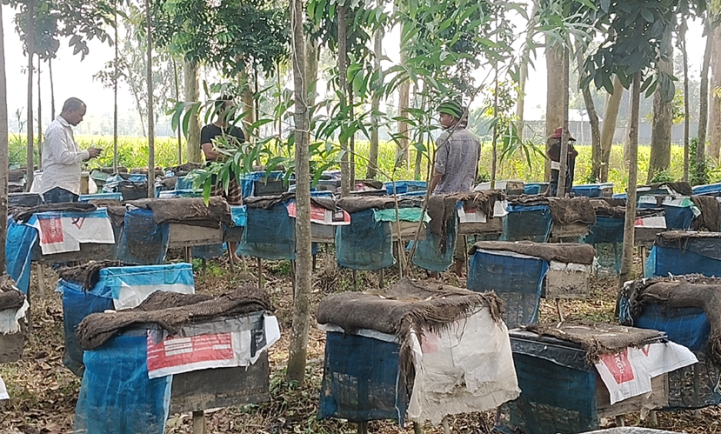
Beekeepers in Sirajganj are making extensive preparations to collect honey during the upcoming mustard flowering season, with around 34,000 beehives set to be installed across the district.
The Department of Agricultural Extension (DAE) estimates that the district could produce around 412 tonnes of honey this season, with an estimated market value of Tk 170 crore.
The potential has created significant business opportunities alongside mustard cultivation, as beekeeping is emerging as an additional source of income and employment in the district.
Beekeepers in Kamarkhand, Belkuchi, Ullapara and Shahjadpur upazilas are currently busy preparing their farms and taking care of bee colonies. They plan to place the boxes near mustard fields as soon as the flowers begin to bloom.
Beekeepers said honey production requires careful planning and considerable labour. For nearly five months of the year, they have to feed bees with sugar and saline-based supplements to keep the colonies alive.
During the flowering seasons of mustard, black cumin, litchi and mango, they move their beehives to different locations to collect honey.
Mohammad Abdul Halim, a beekeeper from Kamarkhand, said the mustard season was the most important period for their business as an abundance of flowers helps ensure higher honey production.
“We are preparing our beehives and bee colonies in advance. However, maintaining bees throughout the year involves considerable expenses for feed, labour and transportation. Fair prices for our honey would encourage beekeepers like us,” he said.
Mohammad Saiful Islam, a beekeeper from Belkuchi, said preparations for the season began well ahead of the flowering period.
He said favourable weather and an adequate supply of flowers were essential for good honey production, adding that ensuring fair prices for pure honey and easier marketing facilities could attract more people to the profession.
According to the Sirajganj DAE, around 270 beekeepers are preparing to install approximately 34,000 beehives across the district this season, with the potential to produce 412 tonnes of honey worth an estimated Tk 170 crore.
A K M Manzure Mawla, deputy director of the district agricultural extension department, said Sirajganj had considerable potential for beekeeping alongside mustard cultivation.
He noted that bees not only collect nectar from mustard flowers but also help pollinate crops, contributing to higher mustard yields.
The DAE is providing beekeepers with necessary advice and assistance to develop the sector, he added.
Industry stakeholders said wider adoption of modern technology, training facilities, easy access to loans, quality control and fair prices could further expand commercial beekeeping in Sirajganj.
The sector could also create new employment opportunities and make a significant contribution to the local economy.