


 Play store

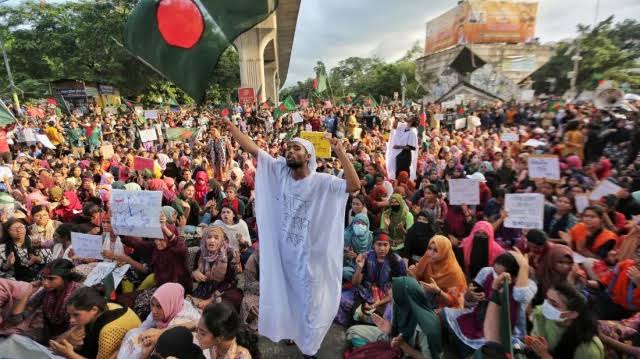
As the Anti-quota student movement continued its forward march braving all odds, by 28 July 2024, ore than 2.13 lakh people—most of them unnamed—had been accused in nearly 200 cases filed with police stations across the capital in connection with the recent violence centring the quota reform movement.
Almost all the cases were filed by the police themselves. Records showed that in at least 16 of those cases, between 5,000 and 10,000 individuals had been accused. Over the preceding 12 days, law enforcement agencies arrested more than 2,500 people, including political leaders, activists, and students, from various parts of Dhaka, according to court documents.
However, the actual numbers of arrests and cases were likely much higher, with police continuing raids across different neighbourhoods of the capital.
The country had witnessed violence on an unprecedented scale in the week prior. What began as peaceful demonstrations turned deadly on July 15, when members of the Chhatra League attacked protesting students on several university campuses. In the days that followed, the violence escalated across Dhaka and beyond, resulting in the deaths of at least 162 individuals.
Amid these developments, six organisers of the quota reform movement—held in custody by the Detective Branch (DB) of police—announced the withdrawal of their protest programmes. The announcement was made via a video message circulated to media outlets from the DB office on Minto Road in the capital.
Nahid Islam, one of the key organisers, appeared in the video alongside five other coordinators. However, the statement drew immediate rejection from another coordinator, Abdul Kader, who accused the DB of coercion.
Speaking through WhatsApp, Kader strongly condemned the “scripted statement” and claimed it had been made “at gunpoint at the DB office.” He declared that protest rallies would be held across the country the following day and reaffirmed the movement’s commitment to its demands.
Meanwhile, a seventh organiser was also allegedly picked up by DB officers. According to his younger sister, Umme Khair Hridi, around 4:00am, eight to 10 men in plain clothes—identifying themselves as DB officials—detained Arif Sohel, a student of international relations at Jahangirnagar University, from his home near the campus.
Then Prime Minister Sheikh Hasina vowed to bring those responsible for the recent violence to justice. While distributing financial assistance to the families of 34 victims at Gono Bhaban—including Abu Sayeed, a student of Rangpur’s Begum Rokeya University—she said, “My effort will be to find those involved in these murders. They must be punished.”
Home Minister Asaduzzaman Khan provided the first official death toll during a press briefing at the Secretariat, stating that at least 147 people had lost their lives in the violence related to the quota reform protests. The victims, he said, included students, professionals, law enforcement officers, and Awami League leaders and activists.
In a statement, the Ministry of Foreign Affairs (MoFA) assured the international community that those responsible for the violence would be brought to justice based on evidence. It emphasised that no reprisal or harassment would be tolerated against protesting students or innocent civilians. Law enforcement agencies, it said, had been given clear instructions in this regard.
Meanwhile, mobile internet was partially restored after more than ten days. However, major social media platforms such as Facebook, WhatsApp, TikTok, and YouTube remained inaccessible.