


 Play store


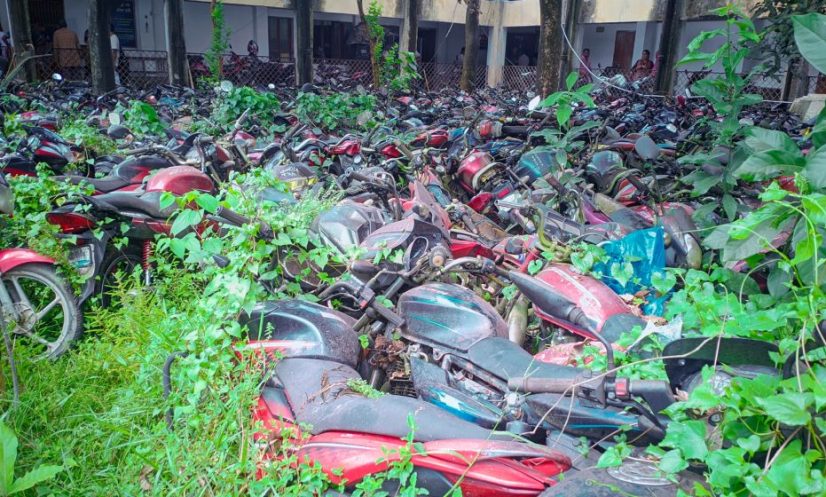
Years of exposure, lengthy trials and inadequate storage threaten valuable public and private assets.Across Bangladesh, court compounds and evidence storage facilities often tell a troubling story: vehicles seized as evidence in criminal cases are left exposed to the sun, rain, dust and humidity for years, turning valuable assets into rusting wrecks.
Motorcycles, cars, trucks, pickup vans, autorickshaws and other vehicles seized in cases ranging from theft and robbery to drug offences and road accidents are supposed to remain protected until courts decide their fate. In practice, however, many are stored in open spaces because of a lack of adequate sheds and secure storage facilities.
The result is a steady loss of value—not only for the owners of the vehicles but also for the state.
The situation at the Thakurgaon court is a stark example of the problem seen in court areas across the country.
More than Tk1 crore worth of seized vehicles have been left exposed to the elements on the court premises for years. Some have lost their seats, doors and windows, while others are so badly rusted that they are approaching the end of their usable life.
During a visit to the area behind the Thakurgaon court on Monday, rows of seized motorcycles, private cars, trucks, pickup vans and autorickshaws were found piled up in front of the BRTA office.
Years of exposure to sunlight, rain and dust have left most of the vehicles in poor condition. In some cases, only rusted metal frames remain.
According to the court’s evidence storage office, vehicles seized in cases filed with different police stations across the district have been kept there since 2004.
The facility currently houses around 200 motorcycles, more than 250 bicycles, a truck, several cars, pickup vans and autorickshaws.
But the legal process often moves far more slowly than the deterioration of the evidence.
Some criminal cases take 10 to 12 years to reach a conclusion. During that period, vehicles that once had considerable market value can lose much of their worth simply by remaining exposed to harsh weather.
Court Sub-Inspector Abdul Malek, who is responsible for the storage facility, said 16 motorcycles were auctioned last month.
But lengthy legal procedures and a shortage of space continue to leave many other vehicles without adequate protection.
The deterioration of seized vehicles creates a problem beyond the loss of physical property.
When a vehicle belongs to a private individual or company, prolonged exposure can significantly reduce its value before it can be returned to its rightful owner following the conclusion of a case.
When the vehicle is eventually cleared for auction, the government may also receive far less than it could have obtained had the asset been properly preserved.
In other words, an asset seized in the name of law enforcement can gradually become a liability because of inadequate preservation.
Abdul Latif, president of the Thakurgaon district unit of Shushashoner Jonno Nagorik (SUJAN), said seized property must be properly preserved as part of the judicial process.
Leaving such property to decay in the open, he said, causes losses to owners and deprives the government of fair prices when the vehicles are auctioned.
Public Prosecutor of the District and Sessions Judge’s Court Md Abdul Halim and lawyer Ashiqur Rahman also called for the legal process to be completed as quickly as possible and for effective measures to protect the seized assets.
The authorities face a difficult balance.Seized vehicles can serve as important evidence in criminal proceedings and cannot simply be handed over, sold or disposed of before the relevant legal procedures are completed.
Chief Judicial Magistrate Md Lutfur Rahman said seized items cannot be handed over without a court order until the cases are concluded.
At the same time, he acknowledged that the lack of dedicated space for the evidence storage facility was contributing to the problem.
He said the authorities would discuss the construction of a shed with the Public Works Department to provide better protection for the seized property.
Preparations were also underway for a large-scale auction in September, he said, which could clear a significant portion of the storage facility.
The Thakurgaon experience highlights a broader need for better management of seized property at courts across Bangladesh.
Keeping valuable vehicles under open skies for years is neither an effective preservation system nor a prudent way to manage public and private assets.
Courts and law enforcement agencies need adequate covered storage, proper inventories, regular inspection and maintenance of seized vehicles. At the same time, cases involving seized assets should be processed without unnecessary delay so that property does not remain in limbo for years.
A centralised system to record seized vehicles, their condition, case status and eligibility for return or auction could also help authorities identify assets that require urgent action.
The objective should not be simply to store seized property until a case ends. It should be to preserve its value and maintain its integrity throughout the judicial process.
For vehicle owners, every year spent under the open sky can mean a substantial financial loss. For the government, every rusting vehicle represents public money and an asset that could have retained considerably more value with proper care.
Evidence may need to remain in custody until justice is served. But there is little justification for allowing valuable property to deteriorate while waiting for that justice.